Monday, November 17, 2014

From Now On Girls, Think Pink!

    This is going to be something of a departure for me, but I think its well within the confines of my goals here.
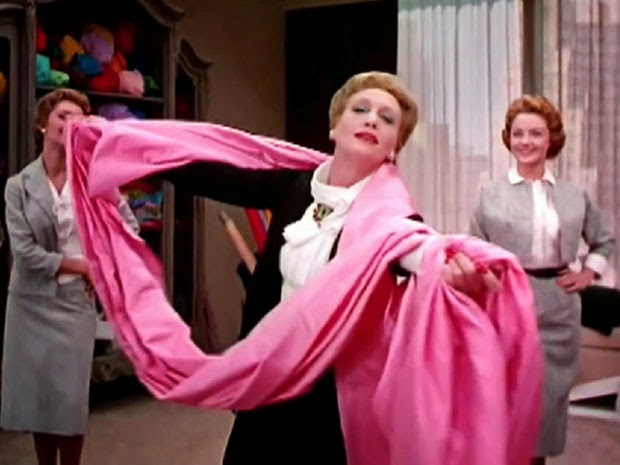
    In 1957 MGM and Stanley Donen produced a musical film called Funny Face, with Fred Astaire, Audrey Hepburn and Kay Thompson.  The film was ostensibly a satire of the fashion industry and the ephemeral nature of style.  But what it was also, was a remarkable picture of how completely our notions about the way we look, and how often we need to alter that, (or even that we need to alter that at all) had shifted in the post war era.
    The vast machine that had been constructed to help move WWII forward, had involved manufacturing at every level and in all categories; and no less was this true in apparel than in any other sphere.  But after the war ended, what were we going to do with all this manufacturing muscle?  If we didn't continue producing at the level we had achieved during the War, people would lose jobs, the economy would slow, and inflation would escalate rapidly.  So, in an effort to keep that from happening, and to keep the profits rolling in, manufacture turned to the concept of "new is better" to keep things going.
    The musical number in the film that nails this concept down solidly, is the first one you see; Think Pink.  The editor of the fashion magazine Quality, is searching for an inspiration for the next issue, and settles on a color theme; which sparks a massive surge in manufacturing across the industry.  The implication that consumers could be motivated to ditch perfectly good items in their wardrobes, because some complete stranger told them to, is powerful, and the satire is both dead on, and viciously arch.
    The 1940s, post war, saw the beginning of a trend that continues today, and has in fact only gained speed and force.  Replacing clothing and accessories that are not worn out, because they are no longer cool.  But along with that came an even more distressing concept that is rife in the apparel industry. Shoddy is good enough.  If a person is going to buy a pair of kicks for 150$ and throw them away in 6 months because Nike says so, why bother making sure they are well constructed?  So makers of goods are foisting off incredibly ill made clothing on us, and getting us to pay dearly for them.  Win for them, but no one else.
    The final, and perhaps most salient thing in the musical number is the idea of the connection between the fashion press, manufacturers, and the buying public.  It is the design community that largely calls the shots, demanding of manufacturers to make what they decide is sellable, and the buying populace is at the end, not the beginning, of that chain.  Sure, if we as customers don't purchase something we're presented, it won't get presented again any time soon; but the prevalence of myriad constantly changing trends, insures that the makers of product end up winning, if for no other reason than the sheer bulk of what is out there.

 Donen got away with quite a lot, with this.


Sunday, November 16, 2014

Making It Law

    Since we started gathering ourselves into groups larger than simple clans and tribes, since we started to have hierarchies within our societies, there have been repeated tries at making certain clothing, fabrics, colors and trimmings inaccessible to some of the population.
    As far back as the Roman Empire, at least in the western world, and far earlier than that in China, there were laws governing the usage of apparel items, and in especial for both those cultures, colors.
    In the roman world, two colors were very carefully controlled. Red, worn as stripes on the toga, was only to be done by members of the senate, and non-citizens were disallowed the color red entirely.
And a certain shade of purple, gleaned from the crushed shells of mollusks was reserved for the Emperor and his family alone because of its extreme rarity. It was the genesis of the term, imperial purple. That same shade of purple was taken on by the Catholic clergy, for use by cardinals and other Papal high rankers, and so, it continued to be carefully guarded. That singular purple is still in use during the Advent season in catholic churches.
    In China, it was a special shade of yellow, a brilliant saturated yellow that was the special province of the emperor and his family.  Others using this color in their attire faced death, though there are no documented cases of this being done.
    Throughout Europe and Asia, from that day, up into the very early 19th century, the ruling classes repeatedly attempted to keep class distinction clear, by outlawing certain things for the bulk of the population.  Once silk became available, through ever growing trade with the East, it became one of the first major textiles to come under the aegis of sumptuary laws.  Other items like lace, and in especial, metal laces in gold and silver, jewels of all sorts, ostrich feathers, cloth of gold or silver, and other rare and costly stuffs were brought under the umbrella of sumptuary law.

    The sad fact, for all those monarchs and elitists was that regardless of how many laws were made, or how severe the punishments were, the sumptuary laws were routinely ignored by the people, as being largely unenforceable.  There are only a tiny number of recorded convictions based on flouting such laws.
    What made this so hard to prosecute was the growing importance of the merchant class, and their subsequent buying power and social influence.  The upper class may not have wanted to associate with them, but they could not ignore them, since they often owed a good deal to them in literal terms.  There was simply put, no way to stop people from dressing better if they had the wherewithal to do so.
    By the time of the French revolution, such laws had faded almost entirely from the world, remaining in place only in closed environments like the royal courts themselves, where it was possible to actually monitor all the people present.  Court environments, most notably the Russian court, had very closely held rules and regulations governing the colors decoration and cut of all the attire worn by the upper class while in attendance at court.
   The last vestiges of such rules exist only in the panoply of churches, and the most rarified of royal state occasions.  We have too much access to too many things, and too little tolerance for that sort of class distinction for this to ever again become a reality.

Saturday, November 15, 2014

Scatter #30

    The weeks roll by fast, no?  Especially as we plunge headlong into that annual craze fest known as the Holidays. But, as you see, I am undaunted.  The scatter goes on, as it should.
   
    This first image made me smile, actually.  This fellow has been making quite a thing of himself of late, with his willingness to at once embody the hypertrophied male ideal with his heavily worked out frame, and the frankly cross dress aspect he is comfortable with presenting.  What I find most intriguing here is how his apparel accentuates and diminishes both concepts at one time.  Its as though his appearance shuttles moment by moment across a continuum of sexuality. He is using his clothing choices to make pronounced and emphatic statements about our gender assumptions, and our attitudes about what is correct and appropriate.  Attire as satire and social commentary. Bravo.
 
     Custom jewelers Tamir produced this piece of dazzle for us to peruse.  Its a roughly 2 carat light yellow diamond, mounted in yellow gold with two pear shaped Colombian emeralds flanking it.  Not much to say about this beyond.  wow.  I admit to a near fatal weakness for emeralds, so there's that.
 
     Next in the line up we have this fantastical over-scaled mohair coat and skirt ensemble. I love the massive nature of it, and the sense of grandeur, though its of such a rough hewn looking fabric. Its a wonderful mix of textures that inspire touch, and help to begin the conversation about who this person is and what she is about.  I also love the hat choice, which recalls the Peruvian Andes and helps take this look to another realm entirely.
 
     Sensuality is helped along a good deal by textile choice.  Sure this image is meant to be sexy, and inspire desire, but the impact of this would be diminished considerably without the hard shine of the sequined fabric he has about him.  Imagine him swathed in something less dramatic.  How would he look in precisely the same pose, wrapped in burlap, or velvet, or in polyester doubleknit.  Sure, it would still be an image of sensuality, but the final message would be subtly different, and that, my friends, is my point.
   
    This back closing sleeveless bolero is completely coated with metal sequins and small scale pyramid studs; turning this into a combination of a wildly luxurious garment, and some sort of armor.  It creates a strong juxtaposition, visually, that I find very interesting.  I'd love to have this in my hands to examine.  I want to know the weight of it and how it moves. In addition, musing about who might own and wear such a garment, makes me predisposed to think them, at very least, someone I'd want to meet.
   
     This is Alice Ernestine Prin, more well known as Kiki de Montparnasse.  She was one of the people who helped to not only define, but develop, the free wheeling culture of Paris in the 1920s.  She was a singer, actress, painter and memoirist.  Her unique style, and fierce modernism inspired those around her in many ways, including her longtime companion the surrealist photographer and artist Man Ray. And her look was the beginning point for what became known as the Garconne' style.  It was a somewhat ambiguous look that allowed women to play about in areas of dress previously held by men.  She died, sadly, at 51, probably from her long dependence on drugs and alcohol.  But her influence helped to change the way women thought of themselves, and how men viewed them.
    This set of remarkable objects are gold finger and toe covers.  They were found in 1905 in Egypt in the tomb of General Kheper-Re.  Even in death we often call on the language of Attire to transmit information about ourselves, our status, and our dreams for ourselves.
    Here are two updated versions of full dress tartan gear.  For myself, I find the one on the left less successful than the right hand one. Perhaps its my modern viewpoint, but the use of the plaid seems overdone, almost costumey, whereas the right hand one seems well balanced.  I also love the fact that the right hand kilt is cut on the bias.  The way that kilt would move would be wonderful, with a good deal more fluid action than typical.
    Okay, so when I first saw this image my jaw fell open.  This is tour de force work here.  Taking knitting and crochet techniques and making them do something quite new.  And the introduction of the pearls and beads into it only adds to the level of amazement.  I am sometimes brought to a halt by human ingenuity.
    And, as a finale today, this image.  Now you might be thinking, "What the hell?", and to be fair, I have had this image hanging around a while, debating internally about whether it was germane to the discussions here.  Obviously, I've decided that it is.  This is such a wonderful example of our obsession with personal transformation, our desire to leap out of our own skins and into something else's, that I really had to show this.   Now, Its clear that the head of this modern minotaur is photoshopped on, but the resulting image is potently meaningful.  Yes, too, its a frankly sexual image, but that's part of the point.  We seem to have this innate need to revisit our animal selves. Sometimes we do that in subtle ways by wearing leather or fur. And sometimes, like here, we need to take that visitation much, much farther.  It comes as no surprise to me that in this time, when the force of techno-culture is shaping more and more of our daily lives, we are finding ourselves more deeply drawn to this aspect of our inner selves.

And that my friends, is this week's scatter.
Have a Splendid Weekend!


Thursday, November 13, 2014

A Gentleman's Banyan

    For well over 200 years the banyan was one of the most important parts of any gentleman's wardrobe.
Why?  Because he likely spent more time in it than anything else, other than his long shirt.  The banyan had a number of names, but its purpose was always the same. It was a means of being in undress while awake, and possibly having company.
    It was meant as informal at home wear, and many a man of arty temperament or leanings had his portrait painted in his banyan, often in his nightcap, or wearing a turban.  In the American colonies in the 1700s, and in particular in those states where it was quite balmy a good deal of the time, the banyan even became informal street wear, as well as at home gear.
    A fellow's banyan was a release from the restrictions of his suits, allowing a great freedom of movement, and ease.  They were often very fully cut, with vast sleeves, and bore no actual closure whatever.
  But as time and styles changed, so did the banyan.  More trimly cut versions emerged, some even with matching sleeves waistcoats that could be worn or not as desired.  And in the later 19th century, before they faded from use, they came to ape the structure and cut of men's outerwear to a good degree.
    Banyan's first came into usage because of increasing trade with the east, where such garments were commonplace.  In fact, one of the other names given to it was the Indian robe.  They were most often made up in fairly heavy weight fabrics, and were typically far more spectacular in color and pattern than a man's everyday wear.  Costly silk brocades, tapestry fabrics, and rare imported stuffs from China, India, and the Middle East were the most sought after for banyans.
 
    Why did they fall out of use?  Well, as more and more men entered the workplace, including men of title, there was a drop in available leisure time, and the connection with an older way of living and thinking was, I suppose, unavoidable. So by the 20th century the banyan had been replaced by the bathrobe, and the smoking jacket. And the smoking jacket only hung on for about 50 years before it became, itself, an anachronism.
    Do I think the banyan could have a place in the modern Attire dialog? Certainly it could.  Sure, most men wouldn't care for something in a material impossible to clean, but updated versions could be done that would well serve the growing population of men, (and women, lets be fair here, boys) who can and do work from home.
    And as a side note. I have one that I made for myself, and I love it.  Not only is it comfortable, but I feel special in it.
   What say we bring this back?  I say lets do this!

Wednesday, November 12, 2014

Romain de Tirtoff

     Romain de Tirtoff (Roman Petrovich Tyrtov) was born to a distinguished Russian family in Saint Petersburg in November of 1892, but lived the vast majority of his life in France and the USA.  His working pseudonym, Erte', was based on the French pronunciation of the initials of his name.  His father, a highly respected Admiral wanted his son to become a naval officer, but Romain's first love was art and design.  So, in 1906 at 24 he had his first encounter with Paris, and moved there in 1910 to pursue seriously a career in design.
     Most people today know him as primarily a creator of elaborate, fantastical costume illustrations, since he re-upped his career in the 70s and 80s marketing his extraordinary illustrative work to the masses.  But his first love, and something that was an important part of his career was his work designing costumes and sets for dance, theater, end eventually for film.
    He did work for the Ballet Russes, for theatrical revues both in Paris and in New York, and for Opera.
  And then, in 1925 he was lured to Hollywood by Louis B Mayer with a generous contract.  The resulting association was fraught with problems, and Erte' didn't long survive the relentless pace and personal restrictions laid on him by Mayer.  He had been brought to MGM to design a film called Paris, but production problems made Mayer assign him to other projects.  He worked on Ben Hur, Dance Madness, Time, The Comedian, and The Mystic. He had previously designed costumes for Marion Davies in the William Randolph Hearst production, Restless Sex in 1920.  Sadly, almost none of these films still survive in their entirety.
    Now what, you might ask, makes Erte' relevant to a discussion of Attire language?  It comes down to this.  His instantly recognizable style influenced not only apparel design in his own time, but created clothing styles decades later; and his artwork and design still affects the work of designers today.  His lean, elegant women became a goal to strive for, a vision of supreme exotic beauty that has called to endless numbers of people, both in and out of the realm of clothing design.
     His drafting of textiles, had little if anything to do with how fabrics actually move and drape, and that sometimes created problems between a rendering and a realized costume, but I just don't care. (smiling)
I'll close this off with a few of my favorite illustrations.

Tuesday, November 11, 2014

Billboarding Our Lives

    We are all painfully aware of the incredible demands being made on our attention daily.  Our personal devices, and computers are the least of it, really.  We are being asked to pay attention to endless news, advertizing, and other things in our world that are attempting to claim us for a moment.  So as a result, for an increasing number of people, the need to be heard and seen in terms of Attire has had its game upped.

    We are no longer, many of us, content to wear our clothes and let them speak for us.  Perhaps we feel the message is neither clear enough, or loud enough to be heard above the growing societal din.  So, we took a concept that had been born in the 60s, the printed tee, and we've run with it.
    Now, we use the basic tee shirt to express in imagery and words, things we cannot express as clearly with our clothes.  Any and all of our opinions and positions are available to be spoken out loud by our tee shirts.  And if there isn't one that says what you want, you can get one custom done on line and shipped to you in days.
    As a social phenomenon, its fascinating. As a variation on the Attire language its entirely new and is daily changing how the language gets used and what, exactly, gets said.
    Though the Attire language is replete with examples of various social, political, even familial connection being expressed by clothing items, colors or patterns.  But the actual use of text in the way its being used now, as declarative statements, is entirely new.  And this new method of sartorial communication is really only just getting its legs under it.  Who knows how far this will go?  Certainly not me.