Here we go, again! Back to the recesses of my cluttered brain, searching through the detritus for things that are worth sharing with you all. Here are this week's gleanings.
The design house Celine is noted for its clean structural clothing, and this effort stuck out for me. Why, you might ask? Well, it's the subtlety of the jacket's shape that struck me. It's a sly manipulation of existing forms into something that speaks differently. And it's the totality that makes it work. By that I mean, the cut, scale of pockets, placement of waistline, and textile choice are all contributing equally to this. What emerges is something that feels nearly Sci FI in its modernity, without veering into costumery. Side note. I will always be in favor of panne' velvet. And I love that intense green in the velvet pants.
One of the advantages of living in a cold climate, like Labrador, is that for a significant part of the year there is little to be done but stay indoors. So what often comes of that fact in such places is that apparel reaches an amazing level of artistry, since there is ample time to devote to it. This coat is of caribou hide and it was made by a Naskapi woman of Labrador in the 1700s. The hide has been well tended, and the surface extensively embroidered in many colors of wool thread. When you look at the clothing of many of the people who live in difficult climates, you will find a similar level of stylistic elevation, and attention to embellishment. We are, after all, endlessly creative.
The wrapped skirt is one of the oldest and simplest garments we have. It is also only one name for such an article. It is simply a length of cloth that is wrapped around and knotted or tucked to stay in place. There are a wide variety of ways this knotting is done and they express regionally, as well as from nation to nation. As a article of practical use it is without peer. It can be worn long, or short, adjusted to allow greater movement, or narrowed for heightened formality. I would love to see this spread to the western world as a regular choice for anyone. Having walked the streets of India, I can tell you there is no reason it cannot coexist with modern urban life. And yes, he is lovely, isn't he?
Five house models show off the latest in daytime wear for 1925. Though most women were still wearing multiple layers underneath, those layers were simpler, lighter and not nearly as restrictive. I can only imagine the feeling of relief it must have been for women who had been adults in the previous few decades. And for the younger women It must have been a subtle but important boost to their growing feelings of independence. With the skirts shortened to this level, nearly any activity became possible, and the looseness of the cut through the torso only added to that literal flexibility. We are fickle creatures, even in the face of such good ideas, and in 20 years women will be torturing themselves into corsets and girdles again to get that waspish waistline that will be the rage.
I really appreciate it when a set of differing textures is rendered in the same color for an ensemble. This is just such an instance. What really makes this sing, though, is the gentle drape of the knit over the shirt, and perfectly rendered choice of decoration on the top. We have smooth worsted, knit, satin, and cotton sateen all in play here. The juxtapositions are subtle and effective. What we as viewers get is a complex and quiet set of messages conveying intellect, education, and oddly, a willingness to think outside the lines. Bravo.
This should be a poster used for a discussion of why editing is so important in design. There are so many players on this field we can't tell who is on what team. the skirt has pale pink silhouettes of flying birds. The sleeves have line drawings of nude women in various poses, filled in in pink, while the collar and bust wrap have light blue cats. Then there is the smocking detail which is mysteriously rendered in three different colors. And finally the over scaled and completely jarring introduction of all that rhinestone jewel embellishment. Color me confounded.
The gentleman's chamber robe, most often referred to as a banyan, began to be supplanted by the mid 1800s by a shorter version, which we have come to call a smoking jacket. This example is from about 1870 and shows us a few things. One is the passion for Orientalia that had swept Europe and America. The pronounced Indian paisley pattern is mixed with Chinese style frog closures. The other is the coloration. Though dyes that achieved similar hues existed before 1860, it is clear from the intensity of the colors that this is the product of aniline dyes. So the gent who owned this was quite a stylish fellow, keeping abreast of the latest fashions in apparel and popular culture.
It is not often that you see sequins worked in this way, completely flat and edge to edge. The fact that they are square adds to the unique quality of this work. It begins to look like a small scale mosaic, which is, doubtless, part of the intent here. What is not readily apparent is that this sort of work must be done in the le main style, because each sequin must be threaded twice so that it stays flat. So you cannot use a tambour hook as you can with a lot of other work. So, though this appears to be a pretty simple thing to accomplish, it's actually quite labor intensive. Twice the time at least. Tadashi Shoji, Fall/Winter 2016.
This suit is from 1792 and is a wonderful look at how societal change can and does affect the Attire language. Just a few years earlier suits were decorated heavily and materials were more visibly ostentatious. With revolution abrew, obvious wealth became a serious problem for personal safety, so it became a good idea to imply one's democratic views by wearing simpler clothing that was of more sober colors. This suit is also a harbinger of the sobriety that will take over menswear entirely in a few years. Darker colors, devoid of decoration will become the norm. So, strange as it might seem, this simple suit tells us quite a lot.
Speaking of Attire items that communicate things,... This handbag is meant to relate one important message. I have money, lots and lots of money. I have so much money that I can afford to have ermine tails dripping from my bag, (which is by the way stuffed with more money). During the 1800s, especially the latter half, the conspicuous display of wealth was not considered a bad thing. Now, if the lady in question was also wearing a huge ermine coat, with a matching hat, and muff, she would have been thought vulgar, but inserting an accessory like this into an ensemble was a clear message to all who saw it.
Cultural appropriation happens within cultures as well as from country to country. We routinely pull ideas from various segments of society, and change them up. We don't think of it as appropriation, because it's within our own borders, but it is a form of it. The vogue in the 1980s for cowboy gear that swept the country creating mock cowboys in Manhattan. The current lumbersexual thing making men look like they chop trees who have never handled an axe in their lives. And here this re-imagining of hippie apparel for the high end market of the 1960s, so that wealthy women could feel counter culture when it suited them. Bottom line is, we take inspiration and ideas from everything we see, all the time, and we always have.
For my final treat this week this amazing headdress from Uzbekistan from the 1800s. To me, when I see things of this sort, I find myself smiling inside about our endless desire to trick ourselves out in fantasy. We are never fully satisfied with anything for long. We want to reach further, be more amazing, more beautified, more idealized. This silver and turquoise headdress is designed with all those feeling taken into account. It is evidently luxurious. The shape of it is carefully crafted to be an enhancement to the face. It also elevates a person, in a literal sense by making them appear taller. And the shimmer of the silver and stones would be beguiling in motion. Along with all this, it is a lovely example of human craft.
So that is the bundle for this week, I hope you enjoyed it. Have a great weekend, my friends!
Saturday, May 14, 2016
Thursday, May 12, 2016
Pandoras
From the 15th century well into the 19th century one very long lived lady did a great deal of fashionable traveling about. Her name was Pandora, and she gadded about all of Europe, visited Russia, and eventually crossed the Atlantic to see the Americas.
From sometime in the 1400s it became the practice to make up dolls that were dressed in the very latest fashions, and then send those dolls out over Europe, to promote trade in textiles and luxury goods, while also letting dressmakers and tailors know what the up to date fashions were. By the later 1600s fashionable dressmakers and tailors would have a few of these dolls sitting about in their shops so that clients could see, in three dimensions, the latest modes.
At their greatest popularity, during the 1700s, there were probably thousands of these dolls circulating the western world, though few of them remain. I suspect that most of them ended up becoming children's toys, and probably got loved to pieces. They were most often painted wood, though there are examples of china Pandoras, and cloth ones as well.
There became two separate versions of Pandora; Greater and Lesser Pandora. Lesser Pandora would be dressed in daytime clothing and accessories, and Greater Pandora was always in evening and formal attire. The dolls were completely togged, including the correct underclothes, stockings, hats, shoes, hairdress and makeup, and even jewelry. It was vital to trade that these dolls be as accurate as possible so that makers of fabrics could sell their newest materials, and purveyors of things like lace and passementerie could get advertising as well.
So important to international trade did these little figures become that they and their carriers were given safe conduct across all borders, even when those nations were at war. It would not surprise me at all if, under such circumstances, these stylish dolls were used as spies, carrying secret information amidst the folds of their clothing.
Though the vast majority of the Pandoras were dressed in female attire, there are a few existing male Pandoras, those that do exist seem to be only for formal dress. And Pandoras were sometimes accessorized even to the extent of having sedan chairs. The idea was, just like it was with fashion plates, not only to present fashion at its most current, but to convey some sense of appropriate comportment as well.
Pandora dolls faded out of use as fashion periodicals took hold and began to dominate the market. Also, the ready availability of a broader range of textiles made their use obsolete. It was not until just after WWII that we would see them again in a pair of unique manners.
One was the Theatre de la Mode, produced by the French couture industry right after the war to remind the world of France's primacy as a center of fashion. Over one hundred dolls, each dressed by different couturiers down to tiny shoes and hats were arranged in a series of environments designed by some of the greatest artists of the time. The Theatre toured both Europe and the United States to great delight.
The other, similar event was the Merci Train, which was produced, again by France, this time as a direct thank you to the United States for their help during the war and after. This collection of dolls chronicled the history of fashion over 250 years, with each doll dressed by a couture house.
Pandora traveled the world and informed a great many people of what was going on in Attire, while also forwarding trade. We are unlikely to see her come back into favor, we have moved beyond the need. But Pandoras do remain to teach us how we did things, and how we thought.
As a final note, the majority of the Theatre de la Mode still exists, and is part of the permanent collection of the Maryhill Museum of Washington state.
From sometime in the 1400s it became the practice to make up dolls that were dressed in the very latest fashions, and then send those dolls out over Europe, to promote trade in textiles and luxury goods, while also letting dressmakers and tailors know what the up to date fashions were. By the later 1600s fashionable dressmakers and tailors would have a few of these dolls sitting about in their shops so that clients could see, in three dimensions, the latest modes.
At their greatest popularity, during the 1700s, there were probably thousands of these dolls circulating the western world, though few of them remain. I suspect that most of them ended up becoming children's toys, and probably got loved to pieces. They were most often painted wood, though there are examples of china Pandoras, and cloth ones as well.
There became two separate versions of Pandora; Greater and Lesser Pandora. Lesser Pandora would be dressed in daytime clothing and accessories, and Greater Pandora was always in evening and formal attire. The dolls were completely togged, including the correct underclothes, stockings, hats, shoes, hairdress and makeup, and even jewelry. It was vital to trade that these dolls be as accurate as possible so that makers of fabrics could sell their newest materials, and purveyors of things like lace and passementerie could get advertising as well.
Though the vast majority of the Pandoras were dressed in female attire, there are a few existing male Pandoras, those that do exist seem to be only for formal dress. And Pandoras were sometimes accessorized even to the extent of having sedan chairs. The idea was, just like it was with fashion plates, not only to present fashion at its most current, but to convey some sense of appropriate comportment as well.
Pandora dolls faded out of use as fashion periodicals took hold and began to dominate the market. Also, the ready availability of a broader range of textiles made their use obsolete. It was not until just after WWII that we would see them again in a pair of unique manners.
One was the Theatre de la Mode, produced by the French couture industry right after the war to remind the world of France's primacy as a center of fashion. Over one hundred dolls, each dressed by different couturiers down to tiny shoes and hats were arranged in a series of environments designed by some of the greatest artists of the time. The Theatre toured both Europe and the United States to great delight.
Pandora traveled the world and informed a great many people of what was going on in Attire, while also forwarding trade. We are unlikely to see her come back into favor, we have moved beyond the need. But Pandoras do remain to teach us how we did things, and how we thought.
As a final note, the majority of the Theatre de la Mode still exists, and is part of the permanent collection of the Maryhill Museum of Washington state.
Tuesday, May 10, 2016
Our Choices
We choose to accept or deny, based on what we see at first glance. It takes a supreme effort on the part of both parties involved to get beyond that. Why? Because what we see right off, is the essential file, the base line information from which we move. It has been thus since we first became erect walking beings who had rational thought as a possibility. Once we acquired the Attire language, uncountable eons ago, we added that level of semiotics to what we perceived about anyone, and everyone who came into our sphere.
So, we do not only perceive about the person's sex, age, or body shape, we perceive multifarious other things that inform us, or misdirect us, about the person in our view. We see the reality, or fantasy of their wealth, status, age, sexuality, religious affiliation, or politics. We see not only who they truly are, but who they imagine themselves to be. Therein lies the deep seated complexity of Attire.
When we present ourselves to the world, however we do so, we are not only making a bald faced statement of fact. We are also communicating an essentially held yearning about ourselves. We are also relaying a dream of who we might wish to be, given the right impetus.
When we look at our fellows on the street, or in the office, think. There is so much more than is apparent. Think. Ponder. Consider. What is it that are you seeing that is only part of the story? That said, the Attire language can help you get to the truth, if you are willing to take time.
The man in tight pants who is in his 50s, is saying more than "I'm randy and ready to go." He is also saying he does not feel ready to let go of his youth. The woman who chooses to wear high heels and short skirts when she is 65 is not just saying "I'm not done yet", she is also possibly giving the finger to the younger generation.
Here is the essential point. We are, all of us, on our own paths to fruition. Whatever that fruition may be, we have only each other to relate to, and only what we present to the world, superficially, to give to it. Most of us have significantly more to contribute than just our presence. But we have to understand that those who see us are grading us on what they perceive. So it is not out of hand for us to meet them a bit, and give them something that they can understand, and relate to.
Here is the front line. We see the people around us constantly. It is an ultimate disservice to them, and to us, to see them as less than they are. If we are to move forward as a species, (for nation must die if we are to do so), then we must learn to see further, deeper, and broader than we currently do. The size 2 woman is not an ideal, she is am aberration. The 6 pack man is not an ideal, he is an aberration. We are all of us beautiful in our ways. We need to learn to embrace, and honor our differences, for those are the things that make us wonderful.
When I was a young lad, I watched Star Trek, I admit it freely. I was a Trek Geek. The single most profound thing to come from that experience was this. It was a tenet of Vulcan philosophy. "Through the many, one". We are magnified by the differences between us, not diminished. When you see someone on the street who is unlike you. Try to understand, not dismiss. It is by this action that we are, as a species, brought closer together.
Saturday, May 7, 2016
Scatter #102
Welcome to Scatter number one hundred and two. We will be bouncing all over the place, as is our usual method, so strap in and enjoy the ride!
This is model Helen Bennett, photographed for Vogue magazine in 1939. What came up for me here were two things really. First is that the image of fully grown up beauty that was the ideal at the time will within just a few years begin to fade out. It will be replaced by an ever more youthful, often girlish image, that becomes more frankly sexual as well. This ladylike vision of stylish rectitude will come to be seen as stodgy. The other thing that comes to mind for me is how much the idea of what is needed to look put together has shifted. The days of hats and gloves being essential parts of the daily wardrobe have gone, perhaps for good. Still, I admire this look, and every time I see one of my customers who assays a sleek retro look like this it makes me smile inside and out.
Get ready, I'm going to be throwing two different man dresses at you today. This one is from Vivienne Westwood. I must admit that I find the runway styling, with whatever that is on the model's face, so distracting that it's hard to focus on the garment. That said, I find it interesting that more designers have moved on from showing men's skirt looks, to men in what we have to call dresses. I suspect that, in order to promote them effectively, they might need a new verbal term. Clearly though, the notion of skirts and dresses on men is beginning to gain ground if so many designers are producing them for the runway. The idea of this, a sheer knitted dress, with an underskirt doesn't bother me at all, though it's not something that would suit all body shapes well. You go, Vivienne!
Speaking of distracting runway styling, here's something from Alexandre Vauthier. I have to admire the level of craft required for the making of this catsuit. Other than that I cannot quite imagine what venue, outside of the bedroom, where this look would play well. Perhaps I'm giving voice to my inner prude. I do understand that some of the work that walks the runway is never really meant to be worn in the real world. This, I suspect is one of those things. Tell me, please, if you can think of a way to incorporate this into real life apparel.
Since the prior image was essentially lingerie, it's only right that the next should be under-gear as well. It is very rare indeed for underclothes to survive over time. In fact, only one other pair of royal underwear exists in a museum. This pair of white linen underpants is from about 1640, so they are soon to be 400 years old. They were worn by Hendrik Kasimir I. Their fabrication is unusual, since the majority of underclothes were made of wool, for warmth. The lighter material may have been for summer use, or simply because it could be afforded, and was less scratchy. Many of Hendrik Krasimir's clothes are on display at the Rijksmuseum in Amsterdam, where this article is also on view.
Textiles, like silhouettes, have their times of popularity, and their times of eclipse. Change taffeta is one material that held great prominence for a good deal of the 1800s. Always made of silk, until the development of rayon in the 1920s, change taffeta gains its shifting hues from the fact that the weft and the warp are two different colors of thread. Add to that that silk fibers, taken in cross section, are translucent prisms and you get that incredible shimmer that defines change taffeta. It fell out of really common usage in the later 1800s, and though it has always been around since, it has been sidelined, for now. Who knows but we might see it gain ground again one day.
I have hidden something form you all. It's a terrible dark secret. But now I must stand tall and admit it. I love brandenburgs. There, it's out in the open at last. I feel so much better. This coat detail shot is of a Saint Laurent menswear piece from the most recent show. Perhaps its the rhythm of them moving down a coat front. Perhaps it's their extravagant look. It might even be the recollection they create of military uniforms. Whatever the reason, I do appreciate them. Naturally, this is not the sort of coat closure that is likely to appear in ready to wear. They are far too time consuming to apply. And perhaps that is another reason why I like them, their rarity.
These days, outside of couture clothing, you would never come across buttons like this. This man's suit button is from 1765. Start with a gold plated disc that is pierced. Mount said plate on a padded fabric backing. Then take paste stones, gold dusted metal sequins, and gold metal purl, and embellish the living daylights out of it. It was common practice for coat buttons to be hand decorated in this manner. And a gift of a set of buttons like this was considered a present of some significance. Then as now, really good buttons are pricey. It is fortunate that coats were rarely buttoned, because these are fragile things that can't take much wear.
Mme Marie Louise Derval was an actress at the beginning of the century who worked on stage and in film in France. I'm giving you a glimpse of her to show this great suit off. As women moved more into the workforce, and also came to be allowed greater freedom in recreation, suits of tweed came to be a popular go to. They were hard wearing, practical garments that could be worn for work, travel or tramping the moors. They were considered quite as suitable in town as in the country. And they had another enormous advantage for women. They were quite easy to care for. No layers of ruffles to be pressed. No lace insertions to fuss over. No layers of beadwork to repair. Once the woman's tweed suit came into being it has never truly left us. We don't see them much in the USA, but just go to the UK, and you'll see they still are out their doing their sensible bit.
I promised you two man dresses. Bet you thought I'd forgotten. The dress is by The Row, and the sneakers are Adidas. The choice of this blush pink is deliberately meant to push buttons. And it does. Combine the subtext of pink being associated with the feminine, and the soft drape of the dress and this can't be anything other than a challenge to our sensibilities. The thing is, render this in some other color, and the message would change a good deal. The basic shape is a worthy one. It could be made to work for a lot of different body types. I approve of this one heartily, and I hope to see more man dresses appear. It's long past time.
It's time for some shiny. This delicious piece of expensive is a pendant lapel watch. It was made in 1925 in France. It's about as straight up a piece of Art Deco styling as I've ever seen. Made up in platinum and white gold it is set with cabochon and faceted emeralds, kite and old cut diamonds, with the watch concealed on the rear face. I strongly suspect that the lucky lady who owned this little goodie had little concern about things like time. (quietly drools)
This is European model Nena von Schlebrugge. The first item today talked about how the whole ladylike thing faded away. This is another image of that shift. Taken in 1959, this image is near the end of the polished lady run. Within just a few years this kind of worldly sophistication will be supplanted by romping, leggy gamines, and stiffly posed space age chicks. Also, this manner of evening dress is about to vanish from view apart from older women and more conservative sorts. It will be replaced by plastic and metal, paper and vinyl in profusion, all done up in stark contrasts and bold patterns. Sorry Nena, but the clock is ticking.
The final item this week is one of the most outrageous mantuas I've even seen. I will apologize for the obviously photoshop fiddled color here, but I haven't found a better image of this. I have seen this dress for reals, and the tone is not much different. This huge edifice of an object was worn by Helen Robinson of Ladykirk in 1760, to a royal ball. This intense yellow, and others like it were immensely popular for a long time in the 1700s, finally dropping from popularity around 1790. That the entire garment is made up in this one material is amazing. She must have been eye searing in a room full of other ladies. The plain stomacher is a museum inset, since the true one is missing. It's also interesting as a sampler of the ways self decoration was employed. There are pleats, gathers, ruchings, and puffs, (sadly flattened) on the skirt, all done in the same textile as the mantua. Also, the full width of the skirt is roughly 2 feet wider than Helen of Ladykirk was tall. Just try to imagine a few dozen women, similarly dressed, trying to maneuver in one room, let alone dance.
Well, that's the lot for this week, I hope you had fun. Now, go enjoy the rest of your weekend!
This is model Helen Bennett, photographed for Vogue magazine in 1939. What came up for me here were two things really. First is that the image of fully grown up beauty that was the ideal at the time will within just a few years begin to fade out. It will be replaced by an ever more youthful, often girlish image, that becomes more frankly sexual as well. This ladylike vision of stylish rectitude will come to be seen as stodgy. The other thing that comes to mind for me is how much the idea of what is needed to look put together has shifted. The days of hats and gloves being essential parts of the daily wardrobe have gone, perhaps for good. Still, I admire this look, and every time I see one of my customers who assays a sleek retro look like this it makes me smile inside and out.
Get ready, I'm going to be throwing two different man dresses at you today. This one is from Vivienne Westwood. I must admit that I find the runway styling, with whatever that is on the model's face, so distracting that it's hard to focus on the garment. That said, I find it interesting that more designers have moved on from showing men's skirt looks, to men in what we have to call dresses. I suspect that, in order to promote them effectively, they might need a new verbal term. Clearly though, the notion of skirts and dresses on men is beginning to gain ground if so many designers are producing them for the runway. The idea of this, a sheer knitted dress, with an underskirt doesn't bother me at all, though it's not something that would suit all body shapes well. You go, Vivienne!
Speaking of distracting runway styling, here's something from Alexandre Vauthier. I have to admire the level of craft required for the making of this catsuit. Other than that I cannot quite imagine what venue, outside of the bedroom, where this look would play well. Perhaps I'm giving voice to my inner prude. I do understand that some of the work that walks the runway is never really meant to be worn in the real world. This, I suspect is one of those things. Tell me, please, if you can think of a way to incorporate this into real life apparel.
Since the prior image was essentially lingerie, it's only right that the next should be under-gear as well. It is very rare indeed for underclothes to survive over time. In fact, only one other pair of royal underwear exists in a museum. This pair of white linen underpants is from about 1640, so they are soon to be 400 years old. They were worn by Hendrik Kasimir I. Their fabrication is unusual, since the majority of underclothes were made of wool, for warmth. The lighter material may have been for summer use, or simply because it could be afforded, and was less scratchy. Many of Hendrik Krasimir's clothes are on display at the Rijksmuseum in Amsterdam, where this article is also on view.
Textiles, like silhouettes, have their times of popularity, and their times of eclipse. Change taffeta is one material that held great prominence for a good deal of the 1800s. Always made of silk, until the development of rayon in the 1920s, change taffeta gains its shifting hues from the fact that the weft and the warp are two different colors of thread. Add to that that silk fibers, taken in cross section, are translucent prisms and you get that incredible shimmer that defines change taffeta. It fell out of really common usage in the later 1800s, and though it has always been around since, it has been sidelined, for now. Who knows but we might see it gain ground again one day.
I have hidden something form you all. It's a terrible dark secret. But now I must stand tall and admit it. I love brandenburgs. There, it's out in the open at last. I feel so much better. This coat detail shot is of a Saint Laurent menswear piece from the most recent show. Perhaps its the rhythm of them moving down a coat front. Perhaps it's their extravagant look. It might even be the recollection they create of military uniforms. Whatever the reason, I do appreciate them. Naturally, this is not the sort of coat closure that is likely to appear in ready to wear. They are far too time consuming to apply. And perhaps that is another reason why I like them, their rarity.
These days, outside of couture clothing, you would never come across buttons like this. This man's suit button is from 1765. Start with a gold plated disc that is pierced. Mount said plate on a padded fabric backing. Then take paste stones, gold dusted metal sequins, and gold metal purl, and embellish the living daylights out of it. It was common practice for coat buttons to be hand decorated in this manner. And a gift of a set of buttons like this was considered a present of some significance. Then as now, really good buttons are pricey. It is fortunate that coats were rarely buttoned, because these are fragile things that can't take much wear.
Mme Marie Louise Derval was an actress at the beginning of the century who worked on stage and in film in France. I'm giving you a glimpse of her to show this great suit off. As women moved more into the workforce, and also came to be allowed greater freedom in recreation, suits of tweed came to be a popular go to. They were hard wearing, practical garments that could be worn for work, travel or tramping the moors. They were considered quite as suitable in town as in the country. And they had another enormous advantage for women. They were quite easy to care for. No layers of ruffles to be pressed. No lace insertions to fuss over. No layers of beadwork to repair. Once the woman's tweed suit came into being it has never truly left us. We don't see them much in the USA, but just go to the UK, and you'll see they still are out their doing their sensible bit.
I promised you two man dresses. Bet you thought I'd forgotten. The dress is by The Row, and the sneakers are Adidas. The choice of this blush pink is deliberately meant to push buttons. And it does. Combine the subtext of pink being associated with the feminine, and the soft drape of the dress and this can't be anything other than a challenge to our sensibilities. The thing is, render this in some other color, and the message would change a good deal. The basic shape is a worthy one. It could be made to work for a lot of different body types. I approve of this one heartily, and I hope to see more man dresses appear. It's long past time.
It's time for some shiny. This delicious piece of expensive is a pendant lapel watch. It was made in 1925 in France. It's about as straight up a piece of Art Deco styling as I've ever seen. Made up in platinum and white gold it is set with cabochon and faceted emeralds, kite and old cut diamonds, with the watch concealed on the rear face. I strongly suspect that the lucky lady who owned this little goodie had little concern about things like time. (quietly drools)
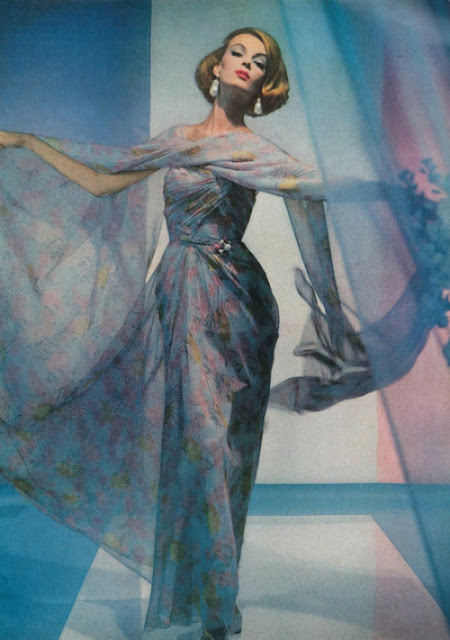
This is European model Nena von Schlebrugge. The first item today talked about how the whole ladylike thing faded away. This is another image of that shift. Taken in 1959, this image is near the end of the polished lady run. Within just a few years this kind of worldly sophistication will be supplanted by romping, leggy gamines, and stiffly posed space age chicks. Also, this manner of evening dress is about to vanish from view apart from older women and more conservative sorts. It will be replaced by plastic and metal, paper and vinyl in profusion, all done up in stark contrasts and bold patterns. Sorry Nena, but the clock is ticking.
The final item this week is one of the most outrageous mantuas I've even seen. I will apologize for the obviously photoshop fiddled color here, but I haven't found a better image of this. I have seen this dress for reals, and the tone is not much different. This huge edifice of an object was worn by Helen Robinson of Ladykirk in 1760, to a royal ball. This intense yellow, and others like it were immensely popular for a long time in the 1700s, finally dropping from popularity around 1790. That the entire garment is made up in this one material is amazing. She must have been eye searing in a room full of other ladies. The plain stomacher is a museum inset, since the true one is missing. It's also interesting as a sampler of the ways self decoration was employed. There are pleats, gathers, ruchings, and puffs, (sadly flattened) on the skirt, all done in the same textile as the mantua. Also, the full width of the skirt is roughly 2 feet wider than Helen of Ladykirk was tall. Just try to imagine a few dozen women, similarly dressed, trying to maneuver in one room, let alone dance.
Well, that's the lot for this week, I hope you had fun. Now, go enjoy the rest of your weekend!
Thursday, May 5, 2016
One Shot: Dress with Changeable Bodice 1865
I've never done two One Shot posts in a row. This object, when it came to my notice, made me stop still. When we look at something like this we are not simply seeing a garment from another time. We are getting a window into the way people thought and felt about themselves, and the world they inhabited. We get a glimpse, albeit through our own lens in the 21st century, of the world they themselves existed in. We get a sense, from a remove, of the rules, restrictions, and also allowances that a certain time permitted.
So, let us look in detail at this dress with two bodices from 1865.
Made in 1856 in France, this dress is entirely of silk, with some simple netting lace, and narrow guimp to finish the trimmings. Dresses of this sort, with two bodices were quite common. It was a practical solution, especially considering the amount of space a dress would take up in storage. A lady could go from day to evening with the same ensemble, and it would take up far less space than two complete dresses.
The skirt is quite simple, allowing the striped material to do all the design work. It is as wide as skirts were going to get, by this time. It has already begun to show the backward trend of shape that will lead to the bustle in about 5 years.
The day bodice has a square neckline trimmed out with solid color pink satin bands that are edged with a slim guimp in pale gold. The sleeves are in the then fashionable pagoda shape, with a gently gathered arcing cuff. There is a complimenting gold velvet belt with a bow, to finish the transition between top and bottom. The dress may have also been worn with what were called mancherons. They were half sleeves that tied at the elbow and fell to the wrist. They would have been common for day use, especially at home. And the lady could remove them when her friends came to call.
The evening bodice is, naturally much more complex in design. It has a broad shallow oval neckline, and tiny puffed sleeves. The Large, pointed bertha collar has a silk under layer, topped with netting lace that is held in place by slim bars of pink silk bias trim, and more of the same guimp used on the day bodice. It also sports a huge decorative bow at the rear waist point, another harbinger of the bustle fashion soon to arrive.
The buttons on the day and evening bodices are silk wrapped, with hand done knotwork decoration on them.
From the type of materials, and the type of decoration in use here, this dress would have been something a woman of better than average means would wear, but certainly not someone of great wealth. There are certain irregularities of construction in the details that would have been unacceptable at the highest level. But for a lady of middle means this is splendid.
So take a good long look through this particular window, and think about what it might have been like in 1865.
Monday, May 2, 2016
One Shot: Callot Soeurs Evening Dress- 1921
I found an amazing work by Callot Soeurs a few days back and posted to the facebook version of Attire's mind. It got me thinking again about this extraordinarily talented design team of two sisters, so I went looking for more and came across this.
1921 was an interesting year, it was smack in the midst of some significant changes both socially and within Attire that would change how women dressed profoundly. This work by the Callot sisters is a great look at that transitional time.
The essential silhouette retains the hip defining look of the teens, when a great deal of women's clothing was draped to accentuate the hipline through the hobble skirt, and the peplumed jackets that were quite popular. The other hold over is the train which would disappear from women's evening fashion outside of the most extremely formal of events.
What establishes this garment as a transitional piece are two things, mainly. The first is the drop of the neckline. It is a touch lower than would have been acceptable just a few years earlier, plus evening wear most often still had at least vestigial sleeves. The other, of course, is the ascending hemline. It hasn't yet reached the level it will achieve in 4 more years, but it's well on its way.
The textile is a silver metallic brocade, printed with birds in a Chinese inspired manner. (It does appear pale gold in the images, but this is due to tarnishing of the silver over time). Though the cut of the dress is approaching the modernity of the chemise that would dominate the decade, the fabric choice keeps a certain stiffness due to the metal threads in its weave, giving the finished piece a certain gravitas it would not have otherwise.
The decorative work is mostly a series of beaded straps done in coral pink and light blue beads, and the center front of the bodice has a large embroidered motif with pendant coral beads on stands of pearls.
One of the other design concepts that had overrun the teens was that of asymmetry. That idea is entirely absent here, with the finished piece relying on perfect side to side balance for a good deal of its impact.
So, this dress steps across two different eras. It nods to the greater formality that was still in place in the 1910s, while reaching with grasping little fingers for the bright future that was the 1920s. For me, a lot of the most interesting items I find are the ones that bridge two stylistic, or social time periods. They express our constant yearning for change in a way that clothing from the midst of an era cannot.
With gratitude to the Chicago History Museum. This dress was worn by one of Chicago's most famous citizens. Mrs Palmer Potter II.
Subscribe to:
Posts (Atom)