Saturday, July 2, 2016

Scatter #108

   Holy Crap, it's July already!  How did this happen?  Well, no matter how quickly the week speeds by, I will not fail in my effort to bring you, weekly a compilation of randomness for your amusement and enlightenment.   Herewith the Scatter for the first week of July 2016.

    Anya Hindmarch seems to like it architectural.  When I saw this I was instantly struck by how much gets accomplished with how little.  The structure of this coat dress could not be simpler, and yet, what could be bland is nothing but, because of the wise choice of textile, and its perfect deployment.  There is rhythm, energy and even a hinting to the body underneath with the intersecting lines implying the shape within.  It's a great textbook image of what happens to a basic garment when a well trained design eye takes it up and works with it.  Boring becomes amazing. And an Attire word that might have communicated little of interest, now relays something strong.
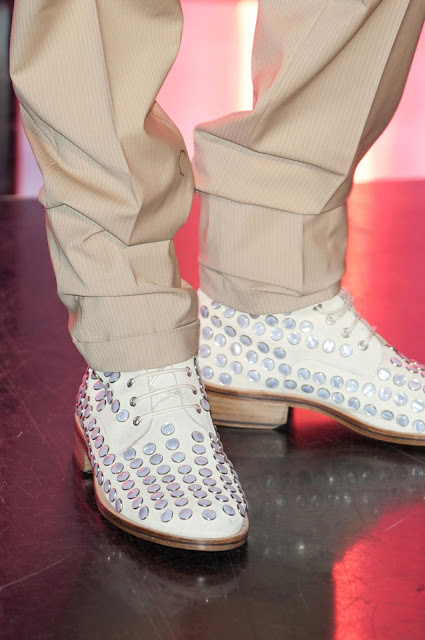
    Here is a great example again of what happens to something simple when a keen design eye is trained on it.  This pair of men's shoes is from a Jean Paul Gaultier collection form 2013. What interests me here is that, first of all, men's shoes so rarely get serious embellishment outside of athletic footwear.  So seeing something with applied work is refreshing.  Second, the choice of decoration is both formal, and playful.  Third, and most interesting to me is that this concept is one that could be done as a DIY project quite easily with a plain pair of shoes and some interesting pieces to apply.  Hmmmm. I might just have to experiment myself.
    These Parisian frillies are a pair of drawers, made in 1900.  By the time these were made it was no longer deeply shocking to wear bifurcated undergarments, women of all sorts did.  What is of interest to me is that it could be seen as the emergence of pants for women in a nearly literal sense.  Within a few more years forward thinking women, especially those with the wealth and freedom to do so, would start wearing pajamas, and resort gear that included pants.  So first it was out of the question, women wore skirts under their skirts, even as sleep gear.  Then during the mid 1800s, they began wearing pantelettes as underclothing, though they were considered very racy. By 1900, they were commonplace, but still invisible to surface view, with the single exception of bloomers.  And by 1950, they were seen daily all over the place.  A slow steady surfacing from subconscious, to conscious.
    This gentleman's coat made me swoon a little when I saw it.  The textile is glorious, a silver metallic brocaded silk frisee velvet.  The cut of this coat marks it as being from between 1730 and 1740, when a man's coat skirts were still to the knee, had considerable volume to the rear, and cuff that went right to the elbow point.  Sadly, the matching breeches no longer exist, but I can still imagine the entire ensemble together.  The suit would have been worn with a shirt with a long fall of lace, white stockings, and the shows, most likely would have had red heels which were a major fashion at the time.  The lucky gent who owned this was either a man of major means, or extreme debt.  Textiles like this one were immensely expensive.
    This cotton lawn day dress is from 1905, and it's a masterpiece of hand work. Lawn is a fabric of such lightness and fragility that it must be handled with great care.  Every stitch mark shows, and won't go away if mistakenly sewn. So imagining the time and care it took to create those arcing bands of inserted lace makes my head hurt a bit, and my fingers ache in sympathy.  Such a gown as this would have been reserved for summer exclusively, since the whole dress probably weighs only a few ounces. And caring for it was also an onerous task, since ironing had to be done with great care so as not to scorch the material.  Milady's maid I'm sure never looked forward to tending this.
    Of late a trend has been around that I have found interesting for what it says about us, and how we want to be perceived by others.  The trend, here presented by KTZ, from 2015 is replete with patches, unified only by color, that are seemingly randomly placed on the frame of the jacket. What I find interesting here is the seeming need we have to advertise ourselves with applied imagery. We are so bombarded with input from every corner of our lives that perhaps it's only natural that we would eventually feel the need to up our game in order to maintain our individuality and relate our interests to others, visually.  In the simplest terms it manifests itself with the current popularity of buttons.  Where I work we carry myriad ones of all sorts that people purchase in bunches to put on hats, backpacks and jackets.  When this peters out, I wonder what will take up the slack, since our culture is hardly getting less frenetic?
    This is an Uzbekistani headdress from the 1890s  I love what it says about our desire to adorn, ennoble, and make ourselves feel important.  And I love too that there is not a culture anywhere on earth that does not utilize the concept of the crown in one form or another.  Whether it's made of hide, feathers and shells, covered over with seed pearls, or made up in precious metals and rare crystalline minerals they exist everywhere and have for all our long history.  Sure, it was an inevitable consequent of our fist sticking leaves in our hair, but that it became a universal is what intrigues me.  So the concept of the crown/headdress is a base term within the Attire language, much like robe, shoe or skirt are.
    I just flat out love this image for so many reasons.  This is a interesting look at how people choose to view themselves, even within a subculture.  The young woman has chosen to follow the dominant fashion trends, and looks right out of a fashion periodical of the time.  The young man, however has chosen to move in a completely counterculture way, referencing his heritage, but making it cool by the shape of his tunic and pants.  We, each of us, find our own way through the seeming morass of Attire, trying to get to a set of words we feel entirely comfortable using, that express our own uniqueness effectively.  NYC 1969.
    Talk about style!  this is German film star Hans Heinrich von Twardowski who was active in film from 1920 to 1944.  I was simply blown away by his appearance. What I'm not certain of is whether this was his actual style or if this was devised for a film he was in. In either case it is an extraordinarily evocative and expressive set of Attire terms.  Every detail contributes. from the cut of his clothes to the tilt of his hat and the sort of flower in his lapel adds to the message.  Even the way he is wearing his gloves makes a small additional remark.  Wonderful, whether it is costume or real time clothing, just wonderful.
    This lovely article is a woman's shirt/chemise from about 1570.  Its survival is probably due to it's having been such an elaborately worked one of its sort.  But it's here to speak to us about how people lived their lives a bit.  Shirts like this from dead plain to highly decorated were a unifying factor of dress for both women and men of every status.  This would have been worn underneath all other clothing, and would often serve as sleep gear.   Much of the extensive embroidery would have been visible to viewers of the lady wearing this. Certainly the gorgeous sleeves would have been on display, either through slits in her oversleeves, or worn fully deployed.  We are lucky indeed that this survives.
    Oh that wacky fellow Walter van Beirendonck.  I must applaud him, ever, for being so willing to take us to new places and try and get us to see things differently, even when those visions are not entirely successful.  As remarkably silly as that coat is, I love its playfulness, and the expert use of the ribbons as they work around the openings.  There is some very fine workmanship on display here,r regardless of the final outcome.  Also, there are ideas here that could translate to real world use.  Could we see coats with bordered cut outs?  Sure we could. And I do like the notion of putting random and unusual areas of the body out there for a look see.  (Also I want those shoes).

I'm finishing this week's Scatter with something rather challenging.  Manish Arora typically creates clothing for women that is lovely and readily understandable.  This statement piece from the S/S 2014 collection is no less easily understood. Its impact is profound, calling to attention the reality of what we are, by bringing our interior outwards and making of it a kind of armor. Perhaps that is the thing that makes this so potent a piece of work. It implies that our internal selves, (and not just our viscera), are indeed our strength and protection.  And yes, in case you were wondering, the cuirass was entirely 3D printed.  Amazing, disturbing, and provocative.

That's that for this week, my friends!  Have fun out there!
   

Monday, June 27, 2016

Sailing Towards Glossolalia

    We consistently get told that we are, of ourselves, not good enough.  We get told not to trust our own worth, that we must have not only the right clothes and accessories, but lots and lots of them in order to be worthy.  When we add into this the ever more massive machine of the Attire industry, we get an outpouring of goods so immense that no person could ever possibly comprehend it all.
    In relation to one of my prime directives here, the Attire language, what I see is that this very flood of goods, each one a new variant word in the lexicon, threatens the very expressive purpose of the language itself.  We can, for example, do a google search on red shoes, and have hundreds, potentially thousands of different images appear.  That being so,  what are we doing to the meaning of the initial phrase red shoes?
    We have become spoiled for choice.  There are so many options, that accurately and cogently relating our meaning through our attire becomes nearly impossible. There is so much interference from the too many options, that we cannot fine tune.  If the effective use of a language is based on both a full understanding of the words you wish to use, and an ability to string those terms together into a coherent statement, then having endless seeming subtle variations of the same word can become problematic.  I suspect that 19th century poets, confronted with the inexplicably huge vocabulary of the contemporary English tongue, (at over 3 million terms), would not have looked on this abundance with complete delight.  If the meaning of the words in a language are largely inaccessible to the huge majority, then what becomes of their purpose?
   In another way of phrasing it, if a language cannot communicate effectively to those who encounter it, then what value, ultimately, does it have?
    I do not believe we have gotten to the glossolalia point as yet. But we are headed there.  It surprises me not at all that some folks resort to a personal uniform so that they can manage to navigate their lives without getting lost in the too much of too much that Attire is becoming.  And this all makes me sad on one level because I see the validity of the Attire language and what it can accomplish so readily.
    We are possessed of an extraordinary communicative system that we have built slowly but surely over thousands of years, that incorporates hundreds of cultures, religions, and sets of political belief, into its substructure.  We have, and still use the Attire language to express our most intimate thoughts and beliefs. We use it to forward our careers, meet a mate, impress constituents, and keep the lines of class well drawn.  We use it to get people to trust us, want us, admire us, and listen to us.  A police officer without their uniform,  is just someone who looks just like us, but in uniform they become something more, because of the Attire language.
    Perhaps I'm being overcautious.  Perhaps I'm seeing something that isn't really there.  That may be, I'm no perfected being with ideal perceptions.  What I am seeing is that more and more often the ways we use the Attire tongue have shifted.  We are employing articles together today that, unless we know someone personally, cannot speak coherently to us.  What might be happening is that the Attire language is now experiencing the same outrageous spurt of growth and change that happened in the internet as it spread and expanded. We find ourselves suddenly with the entire world and all its history of apparel choices open to us.  That, of itself would be reason enough to feel overwhelmed.
    It may well be that Attire as a form of communication is not in any way at risk. It may be that it is simply in the midst of a change of character and focus that will shift how it gets used in ways we never imagined.  For the huge length of human existence what we understood and used of the Attire tongue was limited to our village, our county, our nation.  What happened in the 20th century with the emergence of global transport, was that we discovered that this language, mutually shared, had huge numbers of words of which we knew nothing.  Now, with the omnipresence of the internet, we have the ability to not only see these words, but do the instant research to find out their meaning within the culture where they were born.  Add to that the increasing numbers of people traveling beyond the borders of their home places, and we get an influx of new ideas, new ways of thinking, and new ways of expressing oneself that could become so intense as to immobilize us with regard to how to state ourselves cogently.
    The initial result I see is that more regular folk, and designers are putting entirely random things together, because each one has meaning to them, without regard to whether the final message conveyed looks to be reasoned, or even rational at all.  So, that said, perhaps what is in play is that the language is morphing in order to be able to communicate more complexity that it ever had to before.
    In days gone by it was enough to relate that one was wealthy, or cultivated, or smart, or proficient at something.  Rarely if ever were all these things and more required of a person to put across in their clothing statement.  Now, with the way communications have expanded and changed, it isn't enough anymore to state those bald declaratives.  There has to be more, because our lives are more complex, and our personal realities are more complex on many levels than our forbears.
    What this means in the long run for Attire as an expressive vehicle for us I cannot say.  I will say that observing and taking part in the process is going to be exhilarating, (at least, to me).

Saturday, June 25, 2016

Scatter #107

    Welcome one, and welcome all to this week's version of wandering through my brain.  I hope you enjoy the journey, it's an interesting mix this week if I do say so myself, and I believe that I just did.


     This crown is from Africa and was made in the early part of the 20th century.  Apart from it's undeniable beauty, it speaks to me about the vast and varied ways we have of attempting to elevate ourselves, and create a sense of greater worthiness.  If I hadn't told you this was a crown those of you with no connection to African cultures might have not seen it that way, inculturated as we are about what a crown should look like to western eyes.  Nonetheless this object is meant to convey that the wearer is special and important as much as it's cousins in other places.  We take those things that have meaning for us and place them upon our brows as a symbol to all who see us about our significance in the world.
    Scale and proportion.  These two factors contribute so much to what we see and understand about the apparel statements that we see each day.  Too loose, too tight, too long, too short, or any place within those bounds connects for us in some way and we assign meanings that shift depending on where in those continuuae they fall.  This Delpozo ensemble is a wonderful example of how proportion and scale change our understanding.  Look at this and imagine the same pieces shrunk closer to the body.  Or envision them even more grandly large than they are now.  What happens in your mind when you think of them that way?  How do your feelings about them alter?
    In every culture the world over, part of the raising of children is our largely wordless training of them with apparel for the roles they will fill as adults in society.  These two Kashmiri children, clearly of a wealthy if not noble family, are both already being indoctrinated into the rules and regulations they will be expected to obey, and eventually pass to their children.  We all do this same thing.  Any time a little girl is placed in a pink dress and mary janes, or a little boy gets a miniature denim jacket and cowboy boots we are preserving and forwarding cultural norms of expected behavior and appearance.
    Easiness.  I am loving the influx of menswear options that have this more relaxed and approachable feel.  Not only do clothes like this speak more effectively to our changing world, and our changing views of men, but they specifically lack the kind of alpha male machismo that so often gets produced.  We seem to be learning at last that there are many sorts of men, and that they are all worthy in their own ways.  Is this the physical manifestation of our greater understanding of ourselves?  I believe that it is.   Lucio Vanotti S/S 2017.
    One of the interesting things about old garments is trying to puzzle out their  purpose and meaning.  This gown is from 1900.  Is it a stage costume or a piece of fancy dress?  Is it a starkly modern looking piece that was worn by someone with very advanced tastes?  Sadly I have not been able to find a larger version of this, so getting closer to pick out details like the possibility of other trimmings that have been removed laving stitch marks is not available.  I would, myself think this most likely a piece of fancy dress, or a stage costume.  The sleeves are unlined, which in a real formal dress they would be.  Though the silhouette is essentially correct for the time the severity of it, and its complete lack of trimming call things into question.  I find mysteries like this one fascinating.
    This gentleman's suit is from the early part of the 1700s, about 1720.  First of all, that it survives complete is unusual. Second it gives us a look at the beginning of the concept of the three piece suit which we still have today.  As well, we get to see how much the suit will shift in size and shape in just 80 years.  By 1800 the breeches will hit on or above the knee and be skin tight. The waistcoat will break at the natural waist and have no skirts at all.  The coat will be very trimly cut, with coat fronts that curve backwards to create what became the swallow tailed look that was so very popular for a long time.  And the sleeves of the coat would be cut very close to the form, while shrinking the cuffs down to nothing.  Finally, the coat, and waistcoat would develop a high standing collar, eventually so high as to impede the movement of the head from side to side.
    While this detail image is of a dress from 1880, not 1900 as the earlier one is, this image lets us see what a dress of that general time would look like in terms of how much decoration, and what sort of decoration was normal.  The style of this dress is a recollection of the 1700s with its huge lace cuffs.  The extensive and complex applique beadwork and the elaborate passementerie fringe are high end, but even a middle class or working class woman would have some sort of trim on her clothing, even if it was just decorative bands of the same fabric as the dress.
    The endless ways in which we enhance ourselves, creating a story visual that can be read at a distance by those who understand the words they see is a fascination for me that never palls.  When I see something like this portrait of a Piegan man taken in 1900, it makes me want to know what all the things I'm seeing on him mean within his culture so that I can understand the story he is relating to us.  It is one of the many complexities of the Attire language that within its larger structure there are hundreds of dialects, so a garment can have multiple different meanings depending of the culture it is being used in.  Whew.
   
When I did my post about parures of jewelry a week or so back I mentioned that they existed at many price levels, but it seems that the lower end ones are the ones that did not survive for us to look at.  Well, here is an exception to that.  This parure of plated brass has pressed blue glass cameos of philosophers and gods within borders of cannetille work and filigree mounts.  It is of French manufacture and comes from 1800, when all things relating to ancient Greece and Rome were having an immense impact.  The fact that this is not a precious stone set points out that even women of middle means were possessors of parures.  We are lucky this survives.
    When the automobile emerged the Attire language also created something new, the driving coat.  At first cars were not enclosed and roads not paved, so driving was a dusty business at very least, plus driving in an open car in anything other than summer could be mighty chilly, so covering up served two purposes.  What distinguishes the driving coat from any other one was the cut.  Driving coats were more loosely fitted than a normal town coat, since the gentleman might have to get out and crank the motor, or have to perform some other maintenance function while out and about.  This example is a wool tweed double breasted, from about 1906.
    When  a designer presents an effort like this, I often scratch my head.  What are they thinking of?  What are we supposed to glean from this?  Are we actually supposed to attempt moving about in the real world in something that makes motion so problematic?  Or, as I suspect is the case here, are we to look at this idea and scale it down to human proportions?  When I look at this clownishly enormous sweater, I first realize it has no validity in the real world as it is presented.  But looking at the design itself, with its row of buttons across the shoulder line, I see the worthiness of it. reduce the scale to realistic levels and this becomes a great notion.
    As a final entry this week a pair of the most over the top boots I've ever seen from this period, the 1890s. These twelve button boots are made of pale green silk velvet and gold kidskin.  Both the velvet and the kid are embroidered with vines in dark green and the center tops have metal mesh bows with tassels.  Such extreme footwear was most likely for an actress, dancer or courtesan, since ladies of supposed breeding would have thought these much too much.  Whoever they were for though, they are simply delicious to gaze upon. They make me smile, and I'm glad they are still here so we can all take a peek.

Well that wraps up this week's round up of randomness.  Go enjoy yourselves, and for anyone celebrating Gay Pride, Happy Pride Weekend!

Friday, June 24, 2016

Dancing The Edge Of the Blade

    It's true.  I stand daily on a knife's edge when I talk about Attire.  I do. It seems silly when I think of it, but the truth is that ethically, I do.  On the one side is a passion for design, beauty, and a desire to elevate as many people as possible into that world of sublime luxury and glamour.  On the other I see the uncountable millions who build the clothes we wear, when they cannot ever hope to afford them themselves.
    It creates what seems to be an inescapable problem.  How do we navigate through this?  How do I navigate through this?  How do we find a balance between the entirely legitimate desire to be beautiful, and to have some variance of appearance, with the devouring maw of consumerism that threatens to take us all down in a fury of shoddy products?  What are we to do?
    The fact we cannot turn away from is that, for good or ill, a massive percentage of the world depends upon just that endless pouring forth of ill-considered consumer product.  A huge number of the laborers on the planet are involved in one way or another with the production of the clothing we wear each day.  Farmers, ranchers, truckers, mill workers, warehousemen, spinners, dyers, weavers, designers, cutters, fitters, sewing machine workers, advertisers, shop keepers, stock boys, salespeople, visual merchandisers, and register clerks all take part, even if only tangentially, in this massive process.  There are many more. The makers of buttons, ribbons, zippers, velcro and interfacing, work alongside those who make thimbles, sewing machines, measuring tapes, and tailors chalk.  When we start musing along these lines, it's hard to think of anyone who isn't touching, or touched by this vast industry we have created.
    The fact remains that we have created a monster.  We have.  It must be admitted by anyone rational, that we have created something which now runs entirely out of control, fueled by one overarching goal: PROFIT.
    How do we bring this back to a human scale?  How do we make this again a process where real people get what they really need?  Honestly, I'm not sure.  The fact is that what we see as the Fashion Industry did not exist before the later 1800s.  So it's not like this is something that has gone on for untellable ages that has the force of ancient tradition.  This is something, by human history, really quite new. 
     We have been, and continue to be sold a bill of goods.  The force of media, now so pervasive due to the instant access of the internet, has allowed more and more people to fall thrall to the idealizations and fantasies promoted by the people who most want to sell us things.
     Where in the 1930s, a girl had to wait for the latest issue of Photoplay to see what the Hollywood stars were wearing, she can now see those stars almost moment by moment. We had to deal with an issue of time which has evaporated.  And that is one of the prime concerns we face; the instant nature of our Attire language.  No other spoken or gestural language has had the opportunity to morph with the rapidity, or the breadth, as the Attire language.  It seems to shift instantaneously to our silly whims.  Whatever evanescent thought pops into our heads, it appears as apparel before day's end.  And we have our increasing technology to thank for that, which allows a design to be sent clear around the globe to be manufactured today, for shipment in a few days, to anywhere.
    Here's the thing.  If we are going to move forward further into the 21st century we must take stock about the responsibilities we have both ethically and environmentally with regard to our choices and consumption of goods.  The major question is this.  How do we move forward, wanting what we want about our own lives, while also supporting the lives of the unknown millions who depend upon us for their meager living?  Is there a way to move forward together, or is the system so cancerous that it must be excised like a tumor?   And if it is at last excised, will we survive it? If it does not survive, what replaces it?


Wednesday, June 22, 2016

Finding the Middle Ground

    In my last post I referred to the conundrum we all face about the dissonance between what we get presented by the fashion press and design community, and what our reality requires of us.  But there is more, so much more to that conundrum.
    We get presented a vision of living, where an endless parade of newness overflows into our inboxes daily.  We get shown a plethora of options, most of them of higher price than we would like, that urge us to spend, spend, spend.  And we get told time and again that last season's things are so passe' that we dare not be seen in them, so second hand stores bulge with perfectly wearable clothes, that never really needed to be discarded.  I know this for fact since the vast majority of my wardrobe is, frankly, second hand.
    Within these seemingly silly considerations are others that are far more important. Any of us who pay attention, (and I know you do, because you wouldn't read me if you didn't), know that we are tipping our toes over a precipice where the amount of our consumption of resources will ultimately consume us.  The relentless search for the new for it's own sake has become a cancerous growth that threatens us all. We need only look at the ever more frenzied and outrageous attempts to get our attention by designers with their runway collections to see it.  It is no longer enough to create beautiful, wearable clothes. They must be presented with outrage, fantasy, and almost insane extravagance.
    The immense majority of us, however, live in a world where such things not only are unavailable to us because of price, but have no relevance to our world and lives.
    I, you, we, want to have apparel we like and that serves us well, not only for its utility, but for its ability to enhance us.  At the same time we are also cognizant of living in a world where resources continue to be more limited each day, so the idea of a vast wardrobe of ultimately disposable things stops feeling right.  What happens, at least for me, is that when I look a high fashion image, which I do daily,  I find less and less connection to it outside of a theoretical understanding of objective beauty, or an appreciation of the design concept shown.
     So, where do we go?  What do we do?  Do we abjure the fashionable world and clothe ourselves in only home made togs that we will wear for years?  Do we dive headlong into the deep end of Fashion and forget all about the profligate waste, and the abuse of labor?  Or is there some middle space we can find, some narrow pathway that serves both our desires, and our ethics?  I do not know myself.  I post these questions because they need posting.
     We surely need a retreat from the endless, mindless purchase of more of everything.  Who truly needs 20 pairs of jeans?  Yet I know people who have that many.  I am myself a fool about shoes, with way more pairs than is really needful.  So I'm party to this just like most folks.  We all either know people who have wardrobes vastly bigger than they need, or we are those people ourselves.
    This blog is about how apparel communicates, and that greater numbers of garments create a larger vocabulary.  So you can readily see my difficulty here. My path through this is narrow indeed. How to convey what I believe is a valid set of points, without becoming part of the issue myself.
    So I will leave you with these questions to ponder, both for yourself and for our larger society.
    What constitutes an appropriately sized wardrobe?
    Should we routinely bring more consideration to the selection of our clothes?
    What can we as individuals do to offset, or change the direction we have been going in for so long now.
    And if we are to live smaller, how do we re-employ the millions who would lose work as a result?

    Honestly, when I think on how huge this issue is, it makes my head hurt.

Monday, June 20, 2016

A Personal Conundrum

    We should ourselves decide what is beautiful.
    I have to admit it.  Honestly, I could not take another step with this path, write another word of this blog if I didn't own this.  I, and we, live with a massive conundrum, a dissonance, a disturbance in the force.  That conundrum is this. We all know how divisive and demeaning the apparel industry has become, pitting people against each other for the prize of being the coolest, and most chic. Who has the hottest new Nikes?  Who wears Prada? The ultimate goal being the most lean, hot, hip, and connected person with clothes that convey all that to the random observer. 
    What makes it complex is that we are by our natures profoundly attracted to beauty in its most elevated forms, even though most of us do not have the wherewithal to attain it.  We desire the ultimate. It calls us.  We want to be it.  And the vast majority of us live outside of that goal, and always will.  We have neither the genetics, the fortitude, or the cash to make it so, but still we yearn. We yearn constantly.  We dream and vision. We ache and pine. Sometimes we choose to reject it utterly, though we cannot step entirely outside of the conversation, unless we go nude.
    What we forget is this.  It is we who decide what is beautiful.  You and me, individually decide this incredibly important thing.  Me, you, us.  We decide this. No one else can, or does, unless we give them the power to.  That, to our displeasure, is what we have done.  This massive industry trailing trillions of dollars of profit behind it towers over us giving us pronouncements about what we should be, because we gave them that power over us, willingly.

 
     I will not, cannot allow someone else to decide how and why I should be attractive or worthy.   I spent too many years of my life cowtowing to other people's ideas of what was good and mete. I am my own best judge of myself, noone else. I take my own self to task, and make of myself my own version of beauty and attractiveness.  And this is what we all can do.  It is what we all should do.
    I decide what I believe is beautiful, what I believe is functional, what I believe is worthy.  No one else does.  We, you and me, need to take this power back to us.  If the Attire language is to speak effectively to us all, we must give away the desire to be herd beasts who cling to sameness.  If Attire is to truly become a language that we can all use with equal utility, then we must let go of the dicta of strangers who know not our lives, know not our concerns, and care nothing for our reality.  In reality, if you and me are to become fully ourselves, we have to step away from this obsessive thing we have created and clung to.
    The huge, powerful deity of the Apparel Industry wants one thing above all others, profit.  It seeks not to make you a better person. It cares nothing about your soul, or your needs, or your true desires.  It wants profit.  If it can get profit by pandering to your superficial fantasies, then it will do so.  What is massively sad is this.  The Attire Industry could be even more profitable if it listened, really listened to what we want and need. If it moved itself forward to address the changing realities of the human community, and gave us less sameness and more individuality, it could be even more profitable for them, and even more effective for us all.  If the Apparel Industry served the individual, as technology has finally made possible, then everyone would benefit from it.
    What has happened however is that we have allowed ourselves to be shoehorned into manners of being that have little relation to who we really are, or wish to be, all in service to some fantasy of what is lovely at the moment, that is disseminated to us from fashion media and designers, who have little real world connection to us.
    So, the conundrum remains.  I and you desire this fantastical vision of perfection, even when we know we will never get there. I will never be 5'10" with an 8 pack and a chiseled jaw.  You might never be a size 2 with pneumatic breasts.  Whoever we are, whatever our shape or our coloration we already are beautiful.  At the baseline we are all humans, born of the same family, and living on the same small sphere.  It only remains for the Fashion Industry to understand the fact that we are all beautiful.