"The business of life, is the acquisition of memories."- Mr Carson, Downton Abbey.
What we wear is so very much more than the things we throw on our backs; its our dreams and hopes, our future, and our past. Our history is within the folds and threads, the colors and textures, the quite literal fabric of our being, joined to what we wear each day, though we seldom think of it with any depth.
When I say we are joined literally I mean that. The skin of our bodies, the hair on our heads, and the oils in our skin work their way into the weave of the cloth we wrap around ourselves, in ways that no machine can fully wash away. We become one with our clothing, whether we think of it in those terms or not. The more we wear something, the more imbued with us it becomes, and I don't mean in some evanescent spiritual sense. We leave some of ourselves inside our clothes, when we take them off.
Conversely, the more we wear a garment, the more we value it. The more history and seeming life it gains, makes us give it a great number of meanings; most often positive. I say most often, since for the majority of us in the western world, wearing a garment a great deal means we like it, we choose it above other things we have because it makes us feel special, and more appealing.
A pair of knock around boots we have worn on myriad wonderful hikes, is not only invested with our scent, but layered with the "can't be gotten out" dust and detritus of all those trips. Seeing those boots, we remember, with fondness, maybe even wonder, seeing the Grand Canyon at dawn, or looking back up towards the rim of Haleakala Crater from within its huge expanse.
The pale colored, crocheted baby clothes, put away for years, when drawn out at last, inspire endless remembrances of the birth of a child, and its swift growing up. And perhaps there is just a hint of the smell of baby powder as we open up the tissue paper.
An LBD, bought on sale at the last minute for a party we didn't really want to go to, that came to be the go to dress, whenever it was time to party, because it fit so very well, and could be taken up a notch with ease by adding an accessory or two. We remember it with a smile, not just because it does yeoman service, but because we feel beautiful in it, and its connected to fun and flirtation, and personal successes.
Or perhaps a hoodie, grabbed from a rack in a second hand store, cause it looked and felt really soft and warm, plus the color was great, and it had an image screened on it that made us smile. We picked that hoodie up off the floor and threw it on routinely. It became a friend, and constant companion, and so was full of stories, history and legends.
Next time you go to your closet, take a minute and let your hands rest on some garment you go to often. Take it out, hold it, sniff it,...and remember.
Friday, October 24, 2014
Thursday, October 23, 2014
Menswear Women
The language of Attire does more than allow us to speak our minds in a personalized visual sense; it also operates as a banner that announces, and sometimes carries forward, broader social change. Its difficult, maybe even impossible for folk under 40 to really understand what a huge shake up women's clothing went through in the 20th century. From our 21st century perspective, the notion of women in pants, man tailored shirts, jackets, and coats is one that is a common part of the daily wear of many women, and seeing anyone dressed that way would inspire almost no negative comment whatever.
But a mere eye blink in human history ago, it was not so.
Before the 18th century, women dressing as men in any way was virtually unheard of. Where the change began, was the slow creeping influence of military and riding clothing shapes into women's clothing. Aping the color and decorations of men's military wear, especially during a time of war could get a lady by as being patriotic, or supportive of her husband. And through the offices of royal ladies like Sophie Marie here, menswear inspired riding clothes became first a shocking challenge, and then an accepted part of any stylish ladies wardrobe.
During and after the French Revolution women donned hussar styled jackets and hats, in imitation of Hungarian hussars uniforms.
Once we got into the 19th century shake ups came more often, and with greater impact. During the mid to late 19th century a movement called the Dress Reform Movement was trying with some success, actually, to get both women and men to dress with more sense and practicality. It was from this movement, (about which I'll post another time in more detail), that the Bloomer Girls emerged.
These were the first women to be out in public on the streets and by ways wearing bifurcated garments on their lower bodies rather than skirts. Sure, to our eyes now they look more than a bit silly; but trust me when I say, this was a huge cannon shot right into the heart of women's dress traditions. Did it change everything overnight? Not a bit of it. But it shook the foundations of the edifice that had been women's apparel, and helped make the upcoming changes possible.
By the beginning of the 20th century, edgy couturiers like Poiret were designing harem pants and culottes outfits for women who had style and no fear of reprisals, socially.
And once the First World War happened, and women started doing men's jobs, pants gained even more acceptability. Sure, once the war was over, women dutifully went right back into their dresses and skirts, but the door had been opened, and could never be closed again. Right along side this was the incredibly popular Gibson Girl.
Created by Charles Dana Gibson, his girl was a suffragette, a strong, principled woman, and also quite at home in a man styled shirtwaist with a man's collar and tie, a straw boater and a mannish jacket. She was frequently illustrated by Gibson as being taller and larger than her menfolk, a curious change that infiltrated popular culture.
The thirties and the film industry in the USA pushed things forward as actors like Dietrich and Hepburn took to wearing full on menswear on a pretty regular basis. It increased the acceptability of it across the board and made it all the more reasonable that when World War two happened, women would think nothing of jumping onto overalls and dungarees to get the job done. They never really ever left them again.
Sure, the primacy of menswear looks for women has waxed and waned over the past several decades, but it has remained a presence, and few women now, in Western culture at least, have a wardrobe with no pants, no tailored shirts and no coat that could just as easily pass for menswear.
The Attire language steps up to the plate each time social change is coming, often helping to push things along, by visually exciting and challenging us to think differently. Is the process for women completed with regard to their emancipation from a narrow construct of acceptability in dress? No, of course not, but we can look back along the track of years and see how far we have come, which is very far, indeed.
But a mere eye blink in human history ago, it was not so.
Before the 18th century, women dressing as men in any way was virtually unheard of. Where the change began, was the slow creeping influence of military and riding clothing shapes into women's clothing. Aping the color and decorations of men's military wear, especially during a time of war could get a lady by as being patriotic, or supportive of her husband. And through the offices of royal ladies like Sophie Marie here, menswear inspired riding clothes became first a shocking challenge, and then an accepted part of any stylish ladies wardrobe.
During and after the French Revolution women donned hussar styled jackets and hats, in imitation of Hungarian hussars uniforms.
Once we got into the 19th century shake ups came more often, and with greater impact. During the mid to late 19th century a movement called the Dress Reform Movement was trying with some success, actually, to get both women and men to dress with more sense and practicality. It was from this movement, (about which I'll post another time in more detail), that the Bloomer Girls emerged.
These were the first women to be out in public on the streets and by ways wearing bifurcated garments on their lower bodies rather than skirts. Sure, to our eyes now they look more than a bit silly; but trust me when I say, this was a huge cannon shot right into the heart of women's dress traditions. Did it change everything overnight? Not a bit of it. But it shook the foundations of the edifice that had been women's apparel, and helped make the upcoming changes possible.
By the beginning of the 20th century, edgy couturiers like Poiret were designing harem pants and culottes outfits for women who had style and no fear of reprisals, socially.
And once the First World War happened, and women started doing men's jobs, pants gained even more acceptability. Sure, once the war was over, women dutifully went right back into their dresses and skirts, but the door had been opened, and could never be closed again. Right along side this was the incredibly popular Gibson Girl.
Created by Charles Dana Gibson, his girl was a suffragette, a strong, principled woman, and also quite at home in a man styled shirtwaist with a man's collar and tie, a straw boater and a mannish jacket. She was frequently illustrated by Gibson as being taller and larger than her menfolk, a curious change that infiltrated popular culture.
The thirties and the film industry in the USA pushed things forward as actors like Dietrich and Hepburn took to wearing full on menswear on a pretty regular basis. It increased the acceptability of it across the board and made it all the more reasonable that when World War two happened, women would think nothing of jumping onto overalls and dungarees to get the job done. They never really ever left them again.
Sure, the primacy of menswear looks for women has waxed and waned over the past several decades, but it has remained a presence, and few women now, in Western culture at least, have a wardrobe with no pants, no tailored shirts and no coat that could just as easily pass for menswear.
The Attire language steps up to the plate each time social change is coming, often helping to push things along, by visually exciting and challenging us to think differently. Is the process for women completed with regard to their emancipation from a narrow construct of acceptability in dress? No, of course not, but we can look back along the track of years and see how far we have come, which is very far, indeed.
Wednesday, October 22, 2014
Attire As Transformation
I've spoken and written before about the power of apparel to change us away from the normal run of humanity; and its a subject broad enough and deep enough on its own to bear continued examination. Whether our purpose is merely to carve ourselves a special place to express ourselves, a chance to touch the animal, or spiritual side of us, a sexual need, the placement of ourselves into power, or simply the desire to unsettle, we seem to need to do this, as a species, and to do it with wild creativity.
That need can make itself known with some special tattoos, in less than common places. It means we have taken the idea of these alterations so to heart that we will carry them always. It speaks loudly, because its a permanent commitment to an image, or expression. You cannot really take it back. So any tattoo is a declarative remark; a pronounced one. And such an perpetual statement changes the bearer for life, since, regardless of how they change as a person within themselves, the presence of the mark they chose will always resonate to them, and to any observers.
Sometimes the changes we seek are meant to connect us to power, power over others in a temporal sense. Sometimes that change is so extreme the human becomes completely obliterated within the trappings of that power, as in this image.
We do not know who this person is, not even if this is a male, or female, or other person. All we can know is that we are in the presence of power and mystery. Keeping an observer off balance and unsure is a basic concept for getting, and keeping power.
When we want to get closer to the spiritual we can subject ourselves to a good deal, we will paint, scar, pierce, and otherwise morph ourselves, if it will get us to any perceived nearness to whatever we see as divine. In fact, the act of placing oneself onto this pathway, often painful in the extreme, is considered of itself the door to divine association.
As a side note, I'm aware that this image is not of a real person, but it was so evocative of what I wanted to say, I couldn't resist.
Our need to get closer to our animal part is just as profound, and sometimes we mask ourselves, or dress in hides, or even fake fur, in order to take the qualities of the animal we wish to emulate onto ourselves. We become, in the process, more than human. By backtracking to our more essential natures, we also move forward, and away from normative humanity.
Now and then we give a more deliberately sexual spin to our need to change ourselves up. We trick ourselves out in apparel that has gained, over time, specific fetishized meanings, in order to communicate what we claim to be ourselves, and what we desire from someone else. This image blends a number of divergent concepts together to create a sexual invitation that is complex and layered. But the overall impression is one that has separated this fellow from the commonality.
And finally, sometimes our desire to transform is at heart a desire to disturb; to discompose the viewer.
Who are we seeing here? What do they want? Sometimes we change ourselves to make others ask questions, even when they don't consciously want to. It is a sort of challenge that is an intrinsic part of the Attire dialog. We must ask questions of ourselves and others, often.
Regardless of the deep seated reasons, which we often don't even know ourselves, we have this need to make ourselves different, and special. We want to insure that others know, when dealing with us, that we are meant to be taken into account, not brushed aside. We want, if not to be taken seriously, to be taken as important.
That need can make itself known with some special tattoos, in less than common places. It means we have taken the idea of these alterations so to heart that we will carry them always. It speaks loudly, because its a permanent commitment to an image, or expression. You cannot really take it back. So any tattoo is a declarative remark; a pronounced one. And such an perpetual statement changes the bearer for life, since, regardless of how they change as a person within themselves, the presence of the mark they chose will always resonate to them, and to any observers.
We do not know who this person is, not even if this is a male, or female, or other person. All we can know is that we are in the presence of power and mystery. Keeping an observer off balance and unsure is a basic concept for getting, and keeping power.
When we want to get closer to the spiritual we can subject ourselves to a good deal, we will paint, scar, pierce, and otherwise morph ourselves, if it will get us to any perceived nearness to whatever we see as divine. In fact, the act of placing oneself onto this pathway, often painful in the extreme, is considered of itself the door to divine association.
As a side note, I'm aware that this image is not of a real person, but it was so evocative of what I wanted to say, I couldn't resist.
Our need to get closer to our animal part is just as profound, and sometimes we mask ourselves, or dress in hides, or even fake fur, in order to take the qualities of the animal we wish to emulate onto ourselves. We become, in the process, more than human. By backtracking to our more essential natures, we also move forward, and away from normative humanity.
Now and then we give a more deliberately sexual spin to our need to change ourselves up. We trick ourselves out in apparel that has gained, over time, specific fetishized meanings, in order to communicate what we claim to be ourselves, and what we desire from someone else. This image blends a number of divergent concepts together to create a sexual invitation that is complex and layered. But the overall impression is one that has separated this fellow from the commonality.
And finally, sometimes our desire to transform is at heart a desire to disturb; to discompose the viewer.
Who are we seeing here? What do they want? Sometimes we change ourselves to make others ask questions, even when they don't consciously want to. It is a sort of challenge that is an intrinsic part of the Attire dialog. We must ask questions of ourselves and others, often.
Regardless of the deep seated reasons, which we often don't even know ourselves, we have this need to make ourselves different, and special. We want to insure that others know, when dealing with us, that we are meant to be taken into account, not brushed aside. We want, if not to be taken seriously, to be taken as important.
Tuesday, October 21, 2014
Monday, October 20, 2014
Semiotics
Repeatedly through history clothing has been used in conscious ways to communicate quietly to those who know the signals being transmitted. In 1977 a gentleman named Hal Fischer documented, for the first time, a whole sub-cultures sets of apparel signals.
The emerging Gay community, really coming out of its societal closet for the first time in Western culture was still largely in danger every day. Being overt was tantamount to walking up to someone and asking to be beaten, or thrown out of one's home. So a whole dialect of the Attire language was slowly born that aided both in gay men identifying each other more easily, and with greater confidence; and in some cases within that dialect, simplified the process of determining whether another man was a suitable potential sexual playmate.
The visual tropes that developed were so successful, that they have become iconic images of what people perceive that gay looks like. Though, naturally, the reality is quite different, especially these days.
Here are 6 different images from Fischer's work Gay Semiotics.
Basic Street Fashion, soon to be called the Clone look, so named because it became without question the ubiquitous look for gay men all over the USA; rapidly spreading to other nations. This look, unlike others in the dialect, continues to be a go to for many gay men. And its interesting to note that it spread to the heterosexual community, and is now part and parcel of the male hipster wardrobe right now.
Uniform street wear always incorporated some item that was a part of military or police gear. In addition to what's pictured here, the Air Force flight jacket was very commonly used. Camouflage pants, and jackets, and military issue boots were worn as well. I myself had my Dad's old Air Force captain's uniform jacket. I wore it till it nearly fell apart, then had it copied in leather, and had the service patches moved to the new jacket. It was my personal icon.
Forties Funk next, which I would call retro dressing, myself. The image here is a pretty tame version, frankly, of what was worn; but the clothing of the 30s 40s and 50s was an easy, and at that time, cheap way to dress, that allowed a broader range of expression than the ready to wear for men at the time. So, men of more arty bent often dressed this way. It was certainly one of the dressing tropes I used for myself.
Hippie street fashion. This look, to my mind, is impossible to distinguish from hetero-hippie wear for men with our 21st century perspective. What singles it out is a few subtleties. The amount of jewelry, the bells, and the scarf were all less likely accessories for the straight hippie boys in the crowd. But then again, within the sexually freewheeling counterculture of the hippie movement, the need for overt signals was less important than identification with counterculture overall. Its interesting to note that this look, without a single edit, could walk down the street of a major city without comment today. In fact, the young man sporting this outfit would be considered pretty cool looking.
Jock fashion was a strong look within the Gay Community. Whether the gent in question actually played sports, or was only trying to look like he did was immaterial. What identifies this as a gay signal set is mostly the tightness of the clothing. That, and the average straight guy wasn't going to be running around the streets in work out gear. But the super short, super tight satiny shorts were a commonplace sight within the gay community. The whole look communicated a youthful energy and a connection the masculine pursuits of sport, though filtered through the unique lens of that growing sub-culture.
Lastly, the leather look, which has permeated the entire modern world by now, inspiring couture collections for women and men, and filtering through ready to wear at every level. In this trope the signals are not subtle, nor are they meant to be. This entire look is about presenting oneself not only as a sexual being, but as a fiercely sexual one. Everything here is meant to enhance perceived masculinity, and perceived sexual prowess.
In addition to what you're seeing here, there was the universal hanky code. The hanky code used the many colors of cotton bandana handkerchiefs to operate as a sartorial semaphore system. A man using a particular color in a particular pocket of his jeans or leather pants was deliberately advertizing certain sexual interests. Left pocket, dominant, right pocket, passive. Light blue hanky, oral sex, navy blue, anal sex, red, fisting, and so on. The list is long, and sometimes a trifle confusing. Suffice it to say, if you've never looked at the hanky code listing, you're bound to find a kind of sexual interest you didn't know about before.
What makes this last bit, the hanky code, so interesting is that never before has a system so complex and codified been developed to communicate direct information through apparel. So as an example of the power of Attire to communicate to others it stands as one of the best examples we have. Doubt it not, the Attire language has the ability to speak powerfully, and with great clarity when used to its fullest potential.
The emerging Gay community, really coming out of its societal closet for the first time in Western culture was still largely in danger every day. Being overt was tantamount to walking up to someone and asking to be beaten, or thrown out of one's home. So a whole dialect of the Attire language was slowly born that aided both in gay men identifying each other more easily, and with greater confidence; and in some cases within that dialect, simplified the process of determining whether another man was a suitable potential sexual playmate.
The visual tropes that developed were so successful, that they have become iconic images of what people perceive that gay looks like. Though, naturally, the reality is quite different, especially these days.
Here are 6 different images from Fischer's work Gay Semiotics.
Basic Street Fashion, soon to be called the Clone look, so named because it became without question the ubiquitous look for gay men all over the USA; rapidly spreading to other nations. This look, unlike others in the dialect, continues to be a go to for many gay men. And its interesting to note that it spread to the heterosexual community, and is now part and parcel of the male hipster wardrobe right now.
Uniform street wear always incorporated some item that was a part of military or police gear. In addition to what's pictured here, the Air Force flight jacket was very commonly used. Camouflage pants, and jackets, and military issue boots were worn as well. I myself had my Dad's old Air Force captain's uniform jacket. I wore it till it nearly fell apart, then had it copied in leather, and had the service patches moved to the new jacket. It was my personal icon.
Forties Funk next, which I would call retro dressing, myself. The image here is a pretty tame version, frankly, of what was worn; but the clothing of the 30s 40s and 50s was an easy, and at that time, cheap way to dress, that allowed a broader range of expression than the ready to wear for men at the time. So, men of more arty bent often dressed this way. It was certainly one of the dressing tropes I used for myself.
Jock fashion was a strong look within the Gay Community. Whether the gent in question actually played sports, or was only trying to look like he did was immaterial. What identifies this as a gay signal set is mostly the tightness of the clothing. That, and the average straight guy wasn't going to be running around the streets in work out gear. But the super short, super tight satiny shorts were a commonplace sight within the gay community. The whole look communicated a youthful energy and a connection the masculine pursuits of sport, though filtered through the unique lens of that growing sub-culture.
Lastly, the leather look, which has permeated the entire modern world by now, inspiring couture collections for women and men, and filtering through ready to wear at every level. In this trope the signals are not subtle, nor are they meant to be. This entire look is about presenting oneself not only as a sexual being, but as a fiercely sexual one. Everything here is meant to enhance perceived masculinity, and perceived sexual prowess.
In addition to what you're seeing here, there was the universal hanky code. The hanky code used the many colors of cotton bandana handkerchiefs to operate as a sartorial semaphore system. A man using a particular color in a particular pocket of his jeans or leather pants was deliberately advertizing certain sexual interests. Left pocket, dominant, right pocket, passive. Light blue hanky, oral sex, navy blue, anal sex, red, fisting, and so on. The list is long, and sometimes a trifle confusing. Suffice it to say, if you've never looked at the hanky code listing, you're bound to find a kind of sexual interest you didn't know about before.
What makes this last bit, the hanky code, so interesting is that never before has a system so complex and codified been developed to communicate direct information through apparel. So as an example of the power of Attire to communicate to others it stands as one of the best examples we have. Doubt it not, the Attire language has the ability to speak powerfully, and with great clarity when used to its fullest potential.
Sunday, October 19, 2014
One Shot - Post Crinoline
By the end of the 1850s the cage crinoline had reached the physical maximum it could manage; both technologically, and in terms of how well women could navigate a room. In 1860 that dome d volume began to alter shape. The transition to the first emergence of the bustle silhouette had begun.
This evening dress by Emile Pingat of Paris is not only a perfect example of that transition of shape, but also of the coming vogue for the "more is better" ideal that flooded the Victorian era.
Seen from the front, though the bodice is relatively unchanged from the style in vogue for the prior decade, the skirt is no longer dome shaped, but has become narrower, and conical. Seen from the side, its obvious that the cone shape is not uniform. It skews slightly backwards, drawing the majority of the skirt volume behind the wearer.
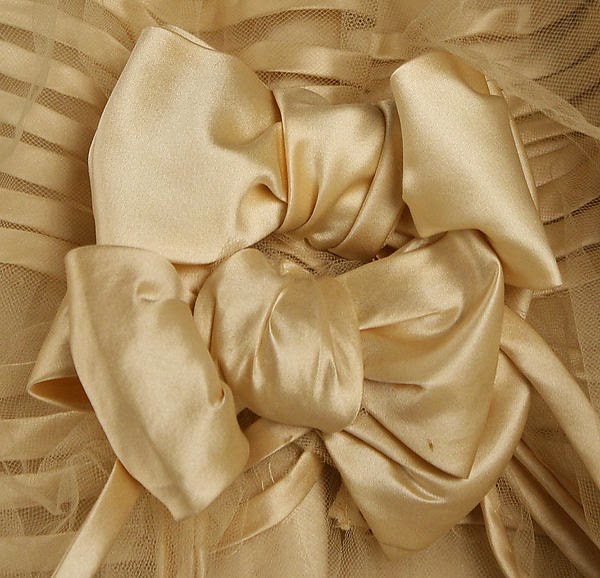
Its also apparent from the recognizable draping in the center back, that will be a defining feature of the bustle, is already making itself known, albeit in silk tulle. In short order this manner of bunching and draping at the base of the back will become a ubiquitous part of women's dress, and be rendered in all manner of textiles.
The other significant alteration of style is that "more is better" thing I mentioned. Where the shape of the dress is quite elegant, there are really far too many detail elements in play, including the large, stiff looped tabs scattered on the dress and bodice. Also, on the skirt alone, the off white silk tulle has been worked in 5 different ways. It has been gathered, ruched, puffed, and pleated in two different manners.
There are, as well, the multiple rows of bias silk banding appliqued onto the tulle over-skirt, the lace, the looping, pendant beadwork on the corsage, the beadwork on the dress tabs, and the alternating colored ribbon bands on the under-skirt. Its a lot of a lot. But in the very near future it becomes the very thing.
As Mr Elias Howe's sewing device gains more and more users, it becomes needful for a lady of fashion to distinguish herself from the rest of the crowd, not only by good workmanship and fine materials, but by ladling on as many decorative details as possible. It becomes the go to method for maintaining class distinction, and remains that way for another 50 years.
Grateful thanks to the Metropolitan Museum of New York and its astounding collection for the images of this amazing garment.
This evening dress by Emile Pingat of Paris is not only a perfect example of that transition of shape, but also of the coming vogue for the "more is better" ideal that flooded the Victorian era.
Seen from the front, though the bodice is relatively unchanged from the style in vogue for the prior decade, the skirt is no longer dome shaped, but has become narrower, and conical. Seen from the side, its obvious that the cone shape is not uniform. It skews slightly backwards, drawing the majority of the skirt volume behind the wearer.
Its also apparent from the recognizable draping in the center back, that will be a defining feature of the bustle, is already making itself known, albeit in silk tulle. In short order this manner of bunching and draping at the base of the back will become a ubiquitous part of women's dress, and be rendered in all manner of textiles.
The other significant alteration of style is that "more is better" thing I mentioned. Where the shape of the dress is quite elegant, there are really far too many detail elements in play, including the large, stiff looped tabs scattered on the dress and bodice. Also, on the skirt alone, the off white silk tulle has been worked in 5 different ways. It has been gathered, ruched, puffed, and pleated in two different manners.
There are, as well, the multiple rows of bias silk banding appliqued onto the tulle over-skirt, the lace, the looping, pendant beadwork on the corsage, the beadwork on the dress tabs, and the alternating colored ribbon bands on the under-skirt. Its a lot of a lot. But in the very near future it becomes the very thing.
As Mr Elias Howe's sewing device gains more and more users, it becomes needful for a lady of fashion to distinguish herself from the rest of the crowd, not only by good workmanship and fine materials, but by ladling on as many decorative details as possible. It becomes the go to method for maintaining class distinction, and remains that way for another 50 years.
Grateful thanks to the Metropolitan Museum of New York and its astounding collection for the images of this amazing garment.
Saturday, October 18, 2014
Scatter #26
Scatterday is Saturday! Here we go, folks. Hang on tight!
Starting us out with a stark blast of glam, that model of a models, Dovima, in Dior, in Paris. This town suit is from the H line, and I love the sharpness, clarity and architecture of it. She has become modern art in the hands of photographer Irving Penn. And how about THAT for a winged eye? She was glam personified in her time. The suit became one of the go to looks for women. It was trifle less fitted in the waist, so it was more forgiving to the less reed-like among us.
Next out of the gate, these 4 tartan bearing fellas. Though the tartan plaid began as a signifier of clan affiliation, it has spread world wide. Its now possible to go to some of the classic kilt makers and get a custom tartan done up for yourself, that will be registered under your name. Also, there are tartans for cites like New York, Paris, and London, a Gay Pride tartan, and even a tartan for the State of California. With that in mind, the clan associations are fading fast, though the love of the tartan plaid is with us still.
Sometimes politics and Attire mix it up to good effect. This is a robe a la Polonaise which gained favor in the late 1700s with the partition of Poland into three segments. Now, looking at this dress one might easily wonder how it relates to political border divisions. Well, the over dress is gathered up on the sides and back into three distinct sections. It was commonplace, particularly in French fashion to subtly refer to current events in such a manner. This fashion managed to survive because it was very attractive, and also practical for walking.
Women are far form being alone is suffering indignities in the name of fashion. Behold the Kaiser Mustache Trainer. For only 50 cents a gentleman would have the dubious honor of wearing this undoubtedly uncomfortable device to bed in order to train his mustaches into good order. If you've ever watched the film of Murder on the Orient Express, you've see Albert Finney, as Poirot using one.
Next, a couple of avant garde pieces that deliberately reference other ages. The left hand one not only mimics the huge ruff collars of the 16th century, but also the drum farthingale. The right hand piece is an homage to the riding habits and militarism of the later 18th century, when Marie Antoinette made it fashionable for ladies to wear menswear styled clothes for riding.
In the 1920s Franklin Price Knott shot this autochrome of a 9 year old Balinese dancing boy. The boy's air of self-possession and poise are at one with the formality and glittering surface of his apparel. I love the complex patterns in play here and the perfect visual balance between his headdress and the volume of his costume.
Giovanni Jacopo Caraglio created this portrait cameo of the Queen of Poland sometime between 1530 and 1540. The cameo is mounted in a beautiful, (but sadly damaged) scrollwork frame of gold with red, green, blue and white enamel. Its enhanced further with a ruby, diamonds and a large pendant baroque pearl. The use of enamel in jewelry was very popular at this time and reached an extremely high level, only ever surpassed by the House of Faberge'.
At first glace you might think there isn't much to be said. Just a cute hipster boy. But the outfit is one that really appeals to me, especially that sweater coat with the points. It takes the essentially unremarkable other elements and lifts the whole thing. A well chosen Attire word has power, my friends, to help the mundane speak with more eloquence.
Yes, this really rather silly, overall. A mite too arch, in fact, but sometimes I love an editorial image, not because it makes me want to run out and try that look but simply for the pleasure of the image. The only thing I could want to see taking off in real world terms is that hat. I think a lot of guys could make this work. Nothing quite like a broad brimmed topper to frame a face well.
And making a short guest appearance, Greta Garbo costumed by Gilbert Adrian in a promotional still for Mata Hari. Was she anything like the real deal? Of course not. Were her clothes in the film referential to either the time or place? Not one little bit. But was she an unforgettable image of woman? Yes, undoubtedly. Her primacy as one of the most beautiful women of her time can now be looked at as a reference to how our notions of beauty alter decade by decade.
That's it for this week's edition of "Roaming Through Paul's Overcrowded Noggin".
Have a wonderful weekend, everyone!
Starting us out with a stark blast of glam, that model of a models, Dovima, in Dior, in Paris. This town suit is from the H line, and I love the sharpness, clarity and architecture of it. She has become modern art in the hands of photographer Irving Penn. And how about THAT for a winged eye? She was glam personified in her time. The suit became one of the go to looks for women. It was trifle less fitted in the waist, so it was more forgiving to the less reed-like among us.
Next out of the gate, these 4 tartan bearing fellas. Though the tartan plaid began as a signifier of clan affiliation, it has spread world wide. Its now possible to go to some of the classic kilt makers and get a custom tartan done up for yourself, that will be registered under your name. Also, there are tartans for cites like New York, Paris, and London, a Gay Pride tartan, and even a tartan for the State of California. With that in mind, the clan associations are fading fast, though the love of the tartan plaid is with us still.
Sometimes politics and Attire mix it up to good effect. This is a robe a la Polonaise which gained favor in the late 1700s with the partition of Poland into three segments. Now, looking at this dress one might easily wonder how it relates to political border divisions. Well, the over dress is gathered up on the sides and back into three distinct sections. It was commonplace, particularly in French fashion to subtly refer to current events in such a manner. This fashion managed to survive because it was very attractive, and also practical for walking.
Women are far form being alone is suffering indignities in the name of fashion. Behold the Kaiser Mustache Trainer. For only 50 cents a gentleman would have the dubious honor of wearing this undoubtedly uncomfortable device to bed in order to train his mustaches into good order. If you've ever watched the film of Murder on the Orient Express, you've see Albert Finney, as Poirot using one.
Next, a couple of avant garde pieces that deliberately reference other ages. The left hand one not only mimics the huge ruff collars of the 16th century, but also the drum farthingale. The right hand piece is an homage to the riding habits and militarism of the later 18th century, when Marie Antoinette made it fashionable for ladies to wear menswear styled clothes for riding.
In the 1920s Franklin Price Knott shot this autochrome of a 9 year old Balinese dancing boy. The boy's air of self-possession and poise are at one with the formality and glittering surface of his apparel. I love the complex patterns in play here and the perfect visual balance between his headdress and the volume of his costume.
Giovanni Jacopo Caraglio created this portrait cameo of the Queen of Poland sometime between 1530 and 1540. The cameo is mounted in a beautiful, (but sadly damaged) scrollwork frame of gold with red, green, blue and white enamel. Its enhanced further with a ruby, diamonds and a large pendant baroque pearl. The use of enamel in jewelry was very popular at this time and reached an extremely high level, only ever surpassed by the House of Faberge'.
At first glace you might think there isn't much to be said. Just a cute hipster boy. But the outfit is one that really appeals to me, especially that sweater coat with the points. It takes the essentially unremarkable other elements and lifts the whole thing. A well chosen Attire word has power, my friends, to help the mundane speak with more eloquence.
Yes, this really rather silly, overall. A mite too arch, in fact, but sometimes I love an editorial image, not because it makes me want to run out and try that look but simply for the pleasure of the image. The only thing I could want to see taking off in real world terms is that hat. I think a lot of guys could make this work. Nothing quite like a broad brimmed topper to frame a face well.
And making a short guest appearance, Greta Garbo costumed by Gilbert Adrian in a promotional still for Mata Hari. Was she anything like the real deal? Of course not. Were her clothes in the film referential to either the time or place? Not one little bit. But was she an unforgettable image of woman? Yes, undoubtedly. Her primacy as one of the most beautiful women of her time can now be looked at as a reference to how our notions of beauty alter decade by decade.
That's it for this week's edition of "Roaming Through Paul's Overcrowded Noggin".
Have a wonderful weekend, everyone!
Subscribe to:
Posts (Atom)