Saturday, June 7, 2014

Friday, June 6, 2014
Scatter #6
Its Scattertime again!
One of the reasons I like doing these now and then, is that I find so very many things in my searching, that I can't get to all of it, so I squirrel things away for other times, and this gives me a chance to let them get seen and talked about.
First up, something quite off the beaten path. This NASA spaceflight suit is well worth looking at because its a synthesis of function and design we rarely see. Even at the couture level, the amount of forethought, specialized workmanship and precision is unknown. When a person's very survival in an environment that resolutely refuses to support life depends on every single element being perfect, its a kind of garment construction none of us will ever encounter. Not one single part of this garment was pulled off a shelf somewhere. The fabric had to be invented, the metal seal rings designed, cast and fitted to amazing tolerances; in short everything you are looking at didn't exist prior to the need for this type of suit.
 This court dress is noteworthy for two reasons, first it is one of the only surviving garments known to exist that belonged to Marie Antoinette of France. Virtually all her extensive wardrobe was either seized or destroyed by the mobs who stormed Versailles. The second reason is that it is also one of the only examples known to exist of the design work of Rose Bertin, who operated as the queen's unofficial Minister of Fashion. In white silk satin, completely embroidered over it surface with a pattern of ribbon swags and chains of flowers, its a gorgeous piece of work, and a testimony to the skill of the many people who worked for Bertin.

 As a garment this ultra-cropped tee is absurd in the extreme. It performs no function really besides that of displaying the worked out chest its wrapped around to great effect. The reason I post this, really is that its emblematic of an interesting social change that is emerging on runways. Men as completely objectified sex images. Never before now have men been presented in the fashion world in this way, whereas women have been dealing with it forever. Tit for tat, say I.
 Ossie Clark was one of the fresh voices in the 70s who was designing something for women that was easy, subtly sexy, and nearly devoid of the badly realized retro references that plagued most of design at that time. This tunic and skirt combo from 1972 is sweet, young and appealing. It must have been delicious to wear something that easy, and free moving.
 Yohji Yamamoto, F/W 2014 menswear collection presented this look on the runway. It appeals to me for a number of reasons. I like all the individual pieces, and I even like them in combination. In real world terms, I would probably want the rope details on the coat scaled back a good deal. But the coat itself is great. I also love the layered, skirted ensemble underneath the coat. And I even love the boots, which I must admit to wanting pretty hard. But for me, the most salient thing that makes this appeal to me is the crossover nature of it. Its blurring gender lines, and I love that.

This woven pearl brooch is from 1820. The intricacy of its design, and the flawlessness of its making up make it a worthy piece for this Scatter. Sure, to modern eyes it seems fussy, but placed on a simple dark colored top and it would sing out loud.
 I post this detail from a painting by Albrecht Durer to give you a peek at the fineness of the construction on that shirt. Just take a good look at the perfectly handled smocking at the neckline. That was most likely a very fine cotton batiste, or a similar lightweight weave. Such smocking would have been done with several parallel rows of stitches. In this case 6 to 8 rows of stitching would have been done to create those ideally rendered tucks. One of the reasons such a level of work was done on shirts was that they were not only the undergarment for daily wear, they were most often used for sleepwear as well. So a shirt would get constant hard wear.
 Bringing up the rear, as usual is another wonderful creation from Charles Frederick Worth. This walking/Visiting costume is from 1889 and is made up in two shades of one of the house materials at Worth, a cotton plush with a pattern of raised dots. Since the textile is (for Worth) pretty restrained he ladled on a few extravagant details. The black silk bows and sash are wonderfully dramatic punctuations to a sedate design. And the lush machine lace jabot gives it a luxurious air that is in keeping with the House's traditions. Madam must have felt magisterial in this.

 That's all for now!
One of the reasons I like doing these now and then, is that I find so very many things in my searching, that I can't get to all of it, so I squirrel things away for other times, and this gives me a chance to let them get seen and talked about.
First up, something quite off the beaten path. This NASA spaceflight suit is well worth looking at because its a synthesis of function and design we rarely see. Even at the couture level, the amount of forethought, specialized workmanship and precision is unknown. When a person's very survival in an environment that resolutely refuses to support life depends on every single element being perfect, its a kind of garment construction none of us will ever encounter. Not one single part of this garment was pulled off a shelf somewhere. The fabric had to be invented, the metal seal rings designed, cast and fitted to amazing tolerances; in short everything you are looking at didn't exist prior to the need for this type of suit.
This woven pearl brooch is from 1820. The intricacy of its design, and the flawlessness of its making up make it a worthy piece for this Scatter. Sure, to modern eyes it seems fussy, but placed on a simple dark colored top and it would sing out loud.
Thursday, June 5, 2014
Game Changers, Part Two
Once we got into the thick of the 1950s, life had stabilized after WWII, and fashion, though attempting as always to move forward, slowed down for a bit. Once we got to the sixties,a coterie of young designers took the existing couture language and turned it on its ear. For once, the style inspirations were coming mostly from the young, and from the street. Yves St Laurent, Paco Rabbane, and Pierre Cardin, were all blasting the way we dressed into orbit.
Yves St Laurent, once he took the reins in his own house, abandoned the more restrained clothes he had done at Dior and took his inspiration from tow primary places, the streets, and from contemporary art. His collection of clothes inspired by Mondrian have become icons, not only of the fusion of art and design, but of the 60s as a whole.

Paco Rabanne grabbed every new material he could think of and made clothes from them vinyl, plastic, paper and metal all formed his new aesthetic of warrior-like clothes that were decidedly furture-modern.

Pierre Cardin was one of the designers to explore unisex clothing, jump suits and the possibilities of polyester fabrics. He also made menswear take a good long look at itself, finally helping a new generation of peacocks find something to wear.
 Though the 1970s was dominated by a series of throw back looks that referred to the 20s, 30s and 40s, the innovations still happened, though what changed things during this decade was less a result of the designers working at the time than it was of the textiles rolling out of mills all over the world. Quiana, new stretch fabrics like Lycra, double knits, both plain faced and embossed, new metallics, and Ultrasuede all made their debuts during this time.
The 80s saw a trio of Japanese designers push the envelop out in ways no one had ever imagined before. Rei Kawabuko, Yohji Yamamoto and Issey Miyake all re-imagined both form and function in new ways, and presented an aesthetic entirely new to the western world.
Rei Kawabuko whose company Comme De Garcons has become a benchmark of the avant garde took, and still takes commonly held western notions of apparel and twists them all out of proportion and recognizability. She is unafraid of mixing wildly disparate textiles and forms to create a new synthesis.
 Yohji Yamamoto's contribution to the Attire conversation is largely about scale. His work brought a new easiness, but moreover a grand size and volume to dressing that still has resonance today.
 And Issey Miyake is perhaps the most visionary of the trio, bringing his relentless experimentation with human proportion, and with function to the runway each year.

 Along with these people Vivienne Westwood, Claude Montana and Thierry Mugler each of them explored other realms. Westwood took on the Punk generation and made the world notice that its ideas were worth serious consideration.
 Montana and Mugler each explored a darker and more potent sexuality in their clothes than had heretofore been on runways. The women they presented were powerful creatures, not to be trifled with. In so doing all three designers helped the women of the world in their continuing quest to be taken seriously in a male dominant society.

 Since that time, with the birth of the internet, the realization that we do indeed inhabit a global village, and the greater ability to produce a clothing line in small scale and get started, the lid has been well and truly blown off. Design is happening everywhere that is forcing the language further. New words are added to the lexicon of Attire nearly daily, and who know where this is all going to lead? I for one find this really exciting. The level of new growth, and of change is exhilarating!
Yves St Laurent, once he took the reins in his own house, abandoned the more restrained clothes he had done at Dior and took his inspiration from tow primary places, the streets, and from contemporary art. His collection of clothes inspired by Mondrian have become icons, not only of the fusion of art and design, but of the 60s as a whole.
Paco Rabanne grabbed every new material he could think of and made clothes from them vinyl, plastic, paper and metal all formed his new aesthetic of warrior-like clothes that were decidedly furture-modern.
Pierre Cardin was one of the designers to explore unisex clothing, jump suits and the possibilities of polyester fabrics. He also made menswear take a good long look at itself, finally helping a new generation of peacocks find something to wear.
The 80s saw a trio of Japanese designers push the envelop out in ways no one had ever imagined before. Rei Kawabuko, Yohji Yamamoto and Issey Miyake all re-imagined both form and function in new ways, and presented an aesthetic entirely new to the western world.
Rei Kawabuko whose company Comme De Garcons has become a benchmark of the avant garde took, and still takes commonly held western notions of apparel and twists them all out of proportion and recognizability. She is unafraid of mixing wildly disparate textiles and forms to create a new synthesis.
Wednesday, June 4, 2014
Game Changers, Part One
With Attire as a language metaphor, the action of the seminal designers who have each in their time shifted the game of fashion design, and created a new set of sartorial words in the bargain becomes important to look at.
Arguably the first name on the list would be Rose Bertin, who became the "Minister of Fashion" to Marie Antoinette, and in so doing began to change how the dialog between makers of clothes and the customer worked. Often she would present the Queen with her creations completed, where before it was an entirely collaborative experience.
 She set the stage for Charles Frederick Worth half a century later to style himself as an artist, and not only get clients to come to him, which was nearly unheard of, but make pronouncements to those clients about what he would and would not do. In addition, he began the long partnership between fabric manufacturers and makers of trims and notions, since he frequently required custom textiles and finishes. His bold hand with design, often focusing on over-scaled, dramatic fabrics, with minimal other details, pushed the language forward, in a day when elaboration, and embellishments of every sort drowned clothing for women.
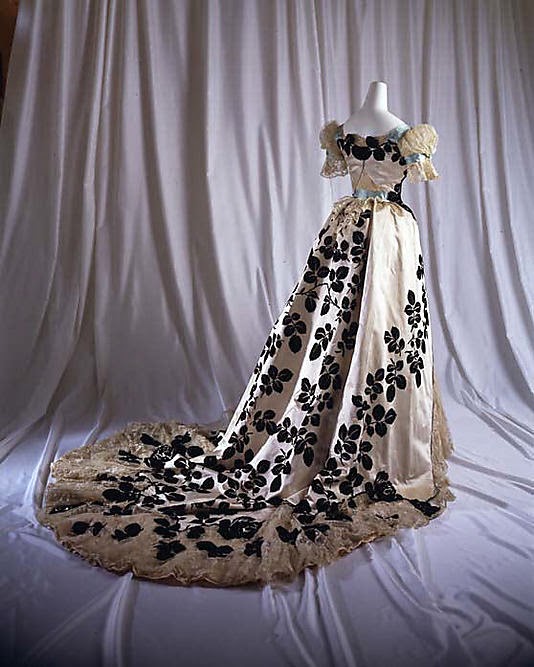 Once we enter the 20th century the number of people who forced the Attire language to new levels of expression increased. The first two designers who exploded the old paradigm were Paul Poiret, And Gabrielle "Coco" Chanel. Monsieur Poiret got women to embrace a more loosely corseted style, and lifted hemlines off the ground for all but the most formal occasions. Under his aegis the number and type of undergarments diminished, allowing a nearly unprecedented freedom of movement to women. Poiret also was the first to produce a house perfume, creating as he did so, one of the mainstays of the couture retail process. A lady might not afford a Poiret dress, but she might splurge on a bottle of scent.


At the same time, Chanel emerged from nowhere, focusing the laser of her design gaze on every frippery and furbelow, blasting them away and leaving the clean lines of modernity that are with us today. She used fabrics that had been heretofore unthinkable for women's clothing, like wool jersey, and made them not only interesting but chic. Her perfume, Number 5, and the masses of costume jewelry she championed, and had designed for her house, added yet another way for women less financially fortunate to get a piece, at least, of the couture experience.
 Then Mr Balenciaga stepped up to the plate, and truly changed things forever. His architectural approach to design, was entirely new, and he took Chanel's notions of editing and tugged them even farther along. The work he did during his career is a continuing inspiration to designers at every level. He was the first designer to create garments from only one or two pieces, and those clothes still stand as some of the most innovative work ever.
 Charles James owed everything he knew to Balenciaga, and took the Master's ideas, and ran with them. Under James' eye, fabrics learned to do things structurally, that they had never done before. Working almost exclusively in solid colors, he made sure it was about structure and volume, and yet, though such a notion could've resulted in coldly clinical results, his work is imbued with an unabashed sensuality.
 The thirties brought Madeline Vionnet to the world design stage, and she went in an entirely other direction from Chanel, Balenciaga, and James. Taking fluid fabrics and allowing them to mold of themselves to the frame, she obliterated the line between the exterior shape and the woman beneath. Her breathlessly lovely designs are a benchmark for easy, fluid sexuality, that manages to avoid the tawdry in the process.

Elsa Schiaparelli brought both surrealism, and a ready, sly wit to clothing. No one before her had allowed serious clothes to also be playful, and cheeky; but she did, and changed how women thought about dressing, forever. Though her house's clothes were never known for the perfection of the workmanship, the sense of fun was palpable, and delicious.
 Rounding out the first half of this discussion, is Christian Dior. After the privations of WWII, Mr Dior reinvented the conversation, bringing a much needed luxe and glamor back to fashion after half a decade of darkness. There were those, then, who decried his work as being referential and backward looking, but he took the pulse of the age, and created a long series of looks that are still part of the Attire language, nearly 70 years later. His full skirted strapless creations still find expression on runways every year, and the way he handled suits and coats gets constant reference as well.
 Tomorrow there are so many more people who shoved us, sometimes kicking and screaming, further along on the sartorial road.
Arguably the first name on the list would be Rose Bertin, who became the "Minister of Fashion" to Marie Antoinette, and in so doing began to change how the dialog between makers of clothes and the customer worked. Often she would present the Queen with her creations completed, where before it was an entirely collaborative experience.
At the same time, Chanel emerged from nowhere, focusing the laser of her design gaze on every frippery and furbelow, blasting them away and leaving the clean lines of modernity that are with us today. She used fabrics that had been heretofore unthinkable for women's clothing, like wool jersey, and made them not only interesting but chic. Her perfume, Number 5, and the masses of costume jewelry she championed, and had designed for her house, added yet another way for women less financially fortunate to get a piece, at least, of the couture experience.
Elsa Schiaparelli brought both surrealism, and a ready, sly wit to clothing. No one before her had allowed serious clothes to also be playful, and cheeky; but she did, and changed how women thought about dressing, forever. Though her house's clothes were never known for the perfection of the workmanship, the sense of fun was palpable, and delicious.
Monday, June 2, 2014
How DO You Tell Your Story?
I made a pretty emphatic pronouncement a few days back about telling your story with Attire. I meant it and I still do. But how do you go about doing that in a conscious, thoughtful way, without bashing people over the head or turning yourself into a cartoon? If the idea here is to present your essential truths and aspirations, then diluting the message seems wrongheaded. But turning your message into a visual scream is not very appealing to most, either. Where is the balance point?
To get to the crux of this seeming conundrum, first you have to come to a clear understanding of what exactly you want to present about yourself. Naturally, for most of us, that is not exactly an easy prospect; but getting as clear as may be is the first best step.
I'm going to go ahead and use myself as a point of reference for this, since I know what my motivations and choices were for the event and outfit that I will discuss.
I was invited, some weeks back, to an industry event called Fashtech, which was about fashion and technology, and was going to have ample opportunity for networking. Now I am a man of a certain age, working my way into this milieu, so what I wore needed to state with clarity that I was able to talk the talk with the rest of the (far younger) crowd. I also figured, rightly as it happens, that a lot of people would default to black as an easy way to go.
So, starting at the bottom here's what I did. Shoes are important. Every woman knows this, and in an industry dominated by women a man is a fool if he ignores that fact. I chose a pair of gunmetal gray metallic leather shoes with black toes.
 My socks were purple. Now, you know that I am a kilt wearing guy, but of late I have been re-introducing pants into the mix, and this evening I wore a pair of brilliant red, trim cut ones. Why? Well, you'll understand as we move upwards.
 My shirt was a lightweight black knit one with a cross fronted hood/cowl. And I wore that with a bolero style black jacket that is a go to of mine that looks like tooled leather. Final touches? Peeking out from under the cowl of my shirt was a costume jewelry necklace of Indian design I had gotten for a costume I intended to make but haven't gotten to yet. It has red, purple, and clear stones in it, in a gold finished metal mounting. And I had a simple black belt.
 So to sum this up, I did the black to create a connection point with me and the others in the room, since its easy to digest; the red to draw the eye, and indicate I can be on point with trend; and two widely separated accessories, one to break up the mass of black and connect the lower half of the look to the upper, and the other to reference the shine of the necklace.
I can tell you that this telling of this part of my story worked quite well. In fact, the venue host came over right away and said that as soon as he caught sight of me that he knew I was someone he had to talk to and find out about. So, job done, tale told. Am I always successful in the telling of my personal tales? No, of course not. I just use myself as an example, because frankly, it was an easy way to approach answering the question of how we actually do tell our story.
So, the simplified, bullet point answer is this. Forethought. Consider what you are going to be doing, who you will be with, and what you hope to achieve, if there is in fact anything conscious you want to get to.
Of course, not every time you step out the door needs to be a chapter in the multi-volume version of you; but introducing, now and again, this kind of consideration to the choices we make, can inform, not only those around us, but ourselves, as we discover things about our own natures through the process.
To get to the crux of this seeming conundrum, first you have to come to a clear understanding of what exactly you want to present about yourself. Naturally, for most of us, that is not exactly an easy prospect; but getting as clear as may be is the first best step.
I'm going to go ahead and use myself as a point of reference for this, since I know what my motivations and choices were for the event and outfit that I will discuss.
I was invited, some weeks back, to an industry event called Fashtech, which was about fashion and technology, and was going to have ample opportunity for networking. Now I am a man of a certain age, working my way into this milieu, so what I wore needed to state with clarity that I was able to talk the talk with the rest of the (far younger) crowd. I also figured, rightly as it happens, that a lot of people would default to black as an easy way to go.
So, starting at the bottom here's what I did. Shoes are important. Every woman knows this, and in an industry dominated by women a man is a fool if he ignores that fact. I chose a pair of gunmetal gray metallic leather shoes with black toes.
I can tell you that this telling of this part of my story worked quite well. In fact, the venue host came over right away and said that as soon as he caught sight of me that he knew I was someone he had to talk to and find out about. So, job done, tale told. Am I always successful in the telling of my personal tales? No, of course not. I just use myself as an example, because frankly, it was an easy way to approach answering the question of how we actually do tell our story.
So, the simplified, bullet point answer is this. Forethought. Consider what you are going to be doing, who you will be with, and what you hope to achieve, if there is in fact anything conscious you want to get to.
Of course, not every time you step out the door needs to be a chapter in the multi-volume version of you; but introducing, now and again, this kind of consideration to the choices we make, can inform, not only those around us, but ourselves, as we discover things about our own natures through the process.
Sunday, June 1, 2014
Scatter #5
Hi all,
I thought that after my last post and its rather emphatic call out it was time for something entirely light. So, a scatter post was in order.
First up, this natty fellow in his plaid suit just plain makes me smile. People who really bring their style to full effect without dilution for public consumption are my day by day heroes. This gentleman numbers among them with his boater, his tie matched to his socks, and that impressive plaid managing to stay balanced with all the other elements of his outfit. Bravo, sir, bravo.

Second item is the wonderful Agnes Moorehead. It made me sad that during her long career she was so very rarely made full on glamorous, and classy. Her characters were so often the tightly wound, careworn sort. Perhaps it was because she was not a conventional beauty, so Hollywood wasn't quite sure what to do with her, but in this film, "Mrs Parkington" she is permitted to be a chic, and brainy lady with tons of class, without giving anything up for it. Her character? Baroness Aspasia Conti.

The extravagance of the 18th century has always had a strong pull for me. Largely its because of things like this. This detail shot of the trimmings of a Robe ala Francais are a testimonial to the skill and craftsmanship, not only of the dressmakers, but of those who wove textiles, and made the complex, fragile and altogether lovely passementerie that decorated the clothes they made. In this case a sinuous band of very wide fly fringe (so named for the tiny tassels that flew away from the surface of the trim, and for their subtle resemblance to insects) has been perfectly matched to the colors of the fabric, and applied perfectly, without a single pucker or pull.

When I came across this image of two Russian soldiers, at first I was puzzled by it. When it finally dawned on me what I was seeing it made me think a good deal. Camouflage material has been around a long time, but we do tend, in the US at least, to think of it as being a pretty static pattern. Clearly that is a mistake. This is how camouflage pattern was done in Russia, before the Revolution. Interesting how such an idea manifests in such radically different ways. But in terms of what its meant to do, I can see that both of these fabrics would do the job nicely, by confusing the eye.

Number five is a piece of sublime bling. This choker is from 1903. Its alternating round cut opals and diamond encrusted sterling flowers with pearl centers. This gorgeous thing must have been stunning in candlelight, viewed across the dining table, or at the theater. Jewelry conveyed something altogether different, back in the day, from the meanings it gives now.

The traditional attire of a Spanish bullfighter, the traja de luces, is without question one of the most opulent garments in the language of Attire for men. Dazzlingly complex in decoration, and skin tight of fit, it manages, though being lavish in the extreme, to be at the same time potently male, and sexy. This image of the decorative work of a suit of lights makes me weak kneed for its artistry.

I suppose its becoming a tradition when I do a scatter post to include one thing by Mr Charles Frederick Worth. I love this piece unreservedly. The Wheat Sheaf gown is of pale rose pink silk satin, with an asymmetrically cut bodice and minimal additional details beyond the huge scaled wheat stalk embroideries of the skirt. Part of what makes this piece amazing to me is that the wheat embroidery was done AFTER the skirt was assembled. The beadwork crosses over each seam line flawlessly, obscuring the joined pieces, rather than the more conventional way of doing the beadwork on the unassembled pieces. This also means that the work was done in the le Main fashion, which takes far longer.

And last but not least this wildly sexy image. You know me and my man-skirt thing. I love em, nearly all iterations of them. And the idea of this full length tartan skirt with the fold over waistband is appealing to me. Sure, Mr Man there is a dish and a half, but I do try to stay focused on the garments in play. What was I just talking about? Never mind.

I thought that after my last post and its rather emphatic call out it was time for something entirely light. So, a scatter post was in order.
First up, this natty fellow in his plaid suit just plain makes me smile. People who really bring their style to full effect without dilution for public consumption are my day by day heroes. This gentleman numbers among them with his boater, his tie matched to his socks, and that impressive plaid managing to stay balanced with all the other elements of his outfit. Bravo, sir, bravo.
Second item is the wonderful Agnes Moorehead. It made me sad that during her long career she was so very rarely made full on glamorous, and classy. Her characters were so often the tightly wound, careworn sort. Perhaps it was because she was not a conventional beauty, so Hollywood wasn't quite sure what to do with her, but in this film, "Mrs Parkington" she is permitted to be a chic, and brainy lady with tons of class, without giving anything up for it. Her character? Baroness Aspasia Conti.
The extravagance of the 18th century has always had a strong pull for me. Largely its because of things like this. This detail shot of the trimmings of a Robe ala Francais are a testimonial to the skill and craftsmanship, not only of the dressmakers, but of those who wove textiles, and made the complex, fragile and altogether lovely passementerie that decorated the clothes they made. In this case a sinuous band of very wide fly fringe (so named for the tiny tassels that flew away from the surface of the trim, and for their subtle resemblance to insects) has been perfectly matched to the colors of the fabric, and applied perfectly, without a single pucker or pull.
When I came across this image of two Russian soldiers, at first I was puzzled by it. When it finally dawned on me what I was seeing it made me think a good deal. Camouflage material has been around a long time, but we do tend, in the US at least, to think of it as being a pretty static pattern. Clearly that is a mistake. This is how camouflage pattern was done in Russia, before the Revolution. Interesting how such an idea manifests in such radically different ways. But in terms of what its meant to do, I can see that both of these fabrics would do the job nicely, by confusing the eye.
Number five is a piece of sublime bling. This choker is from 1903. Its alternating round cut opals and diamond encrusted sterling flowers with pearl centers. This gorgeous thing must have been stunning in candlelight, viewed across the dining table, or at the theater. Jewelry conveyed something altogether different, back in the day, from the meanings it gives now.
The traditional attire of a Spanish bullfighter, the traja de luces, is without question one of the most opulent garments in the language of Attire for men. Dazzlingly complex in decoration, and skin tight of fit, it manages, though being lavish in the extreme, to be at the same time potently male, and sexy. This image of the decorative work of a suit of lights makes me weak kneed for its artistry.
I suppose its becoming a tradition when I do a scatter post to include one thing by Mr Charles Frederick Worth. I love this piece unreservedly. The Wheat Sheaf gown is of pale rose pink silk satin, with an asymmetrically cut bodice and minimal additional details beyond the huge scaled wheat stalk embroideries of the skirt. Part of what makes this piece amazing to me is that the wheat embroidery was done AFTER the skirt was assembled. The beadwork crosses over each seam line flawlessly, obscuring the joined pieces, rather than the more conventional way of doing the beadwork on the unassembled pieces. This also means that the work was done in the le Main fashion, which takes far longer.
And last but not least this wildly sexy image. You know me and my man-skirt thing. I love em, nearly all iterations of them. And the idea of this full length tartan skirt with the fold over waistband is appealing to me. Sure, Mr Man there is a dish and a half, but I do try to stay focused on the garments in play. What was I just talking about? Never mind.
Subscribe to:
Posts (Atom)