Hi all,
I thought that after my last post and its rather emphatic call out it was time for something entirely light. So, a scatter post was in order.
First up, this natty fellow in his plaid suit just plain makes me smile. People who really bring their style to full effect without dilution for public consumption are my day by day heroes. This gentleman numbers among them with his boater, his tie matched to his socks, and that impressive plaid managing to stay balanced with all the other elements of his outfit. Bravo, sir, bravo.
Second item is the wonderful Agnes Moorehead. It made me sad that during her long career she was so very rarely made full on glamorous, and classy. Her characters were so often the tightly wound, careworn sort. Perhaps it was because she was not a conventional beauty, so Hollywood wasn't quite sure what to do with her, but in this film, "Mrs Parkington" she is permitted to be a chic, and brainy lady with tons of class, without giving anything up for it. Her character? Baroness Aspasia Conti.
The extravagance of the 18th century has always had a strong pull for me. Largely its because of things like this. This detail shot of the trimmings of a Robe ala Francais are a testimonial to the skill and craftsmanship, not only of the dressmakers, but of those who wove textiles, and made the complex, fragile and altogether lovely passementerie that decorated the clothes they made. In this case a sinuous band of very wide fly fringe (so named for the tiny tassels that flew away from the surface of the trim, and for their subtle resemblance to insects) has been perfectly matched to the colors of the fabric, and applied perfectly, without a single pucker or pull.
When I came across this image of two Russian soldiers, at first I was puzzled by it. When it finally dawned on me what I was seeing it made me think a good deal. Camouflage material has been around a long time, but we do tend, in the US at least, to think of it as being a pretty static pattern. Clearly that is a mistake. This is how camouflage pattern was done in Russia, before the Revolution. Interesting how such an idea manifests in such radically different ways. But in terms of what its meant to do, I can see that both of these fabrics would do the job nicely, by confusing the eye.
Number five is a piece of sublime bling. This choker is from 1903. Its alternating round cut opals and diamond encrusted sterling flowers with pearl centers. This gorgeous thing must have been stunning in candlelight, viewed across the dining table, or at the theater. Jewelry conveyed something altogether different, back in the day, from the meanings it gives now.
The traditional attire of a Spanish bullfighter, the traja de luces, is without question one of the most opulent garments in the language of Attire for men. Dazzlingly complex in decoration, and skin tight of fit, it manages, though being lavish in the extreme, to be at the same time potently male, and sexy. This image of the decorative work of a suit of lights makes me weak kneed for its artistry.
I suppose its becoming a tradition when I do a scatter post to include one thing by Mr Charles Frederick Worth. I love this piece unreservedly. The Wheat Sheaf gown is of pale rose pink silk satin, with an asymmetrically cut bodice and minimal additional details beyond the huge scaled wheat stalk embroideries of the skirt. Part of what makes this piece amazing to me is that the wheat embroidery was done AFTER the skirt was assembled. The beadwork crosses over each seam line flawlessly, obscuring the joined pieces, rather than the more conventional way of doing the beadwork on the unassembled pieces. This also means that the work was done in the le Main fashion, which takes far longer.
And last but not least this wildly sexy image. You know me and my man-skirt thing. I love em, nearly all iterations of them. And the idea of this full length tartan skirt with the fold over waistband is appealing to me. Sure, Mr Man there is a dish and a half, but I do try to stay focused on the garments in play. What was I just talking about? Never mind.
Sunday, June 1, 2014
Saturday, May 31, 2014
Saturday, May 24, 2014
Thursday, May 22, 2014
Festival!
We rarely really let our selves out to play. When we do, and especially when that play is associated with cultural traditions, the way we manifest our attire gets pretty amazing. All over the world, when it comes to festival times there are some common factors that always emerge. The first is color; brilliant, saturated color, and lots of it.
Ghana
Peru
Swazi Reed Dance Festival
Second is abundance, often in the form of volume, but also often in lush embroideries and decorative details.
Spain
Montenegro
Poland
Third is a sense of joy. There is a common thread, (you should pardon the pun) that runs through the attire of festival clothing the world over, and that is an aspect of visual delight, and playfulness. No matter the seriousness of the occasion, there is an underlying gleefulness that is inescapable.
Wodaabe Men
In Europe and most of the rest of the Western world, traditional festival attire is heavily embroidered in multiple colors, and the various shirts, skirts, vests and pants are often handed down generationally, since they are both family keepsakes, and also the product of possibly thousands of hours of loving work. This is especially true of places where life is often harsh because of the climate. Long months shuttered indoors away from icy winds and snow leave hands with time to spare, and it was both a way to while away hours, and also to keep a lighter attitude, working on something bright colored and happy in the dimness of winter.
Czechoslovakia and Bulgaria
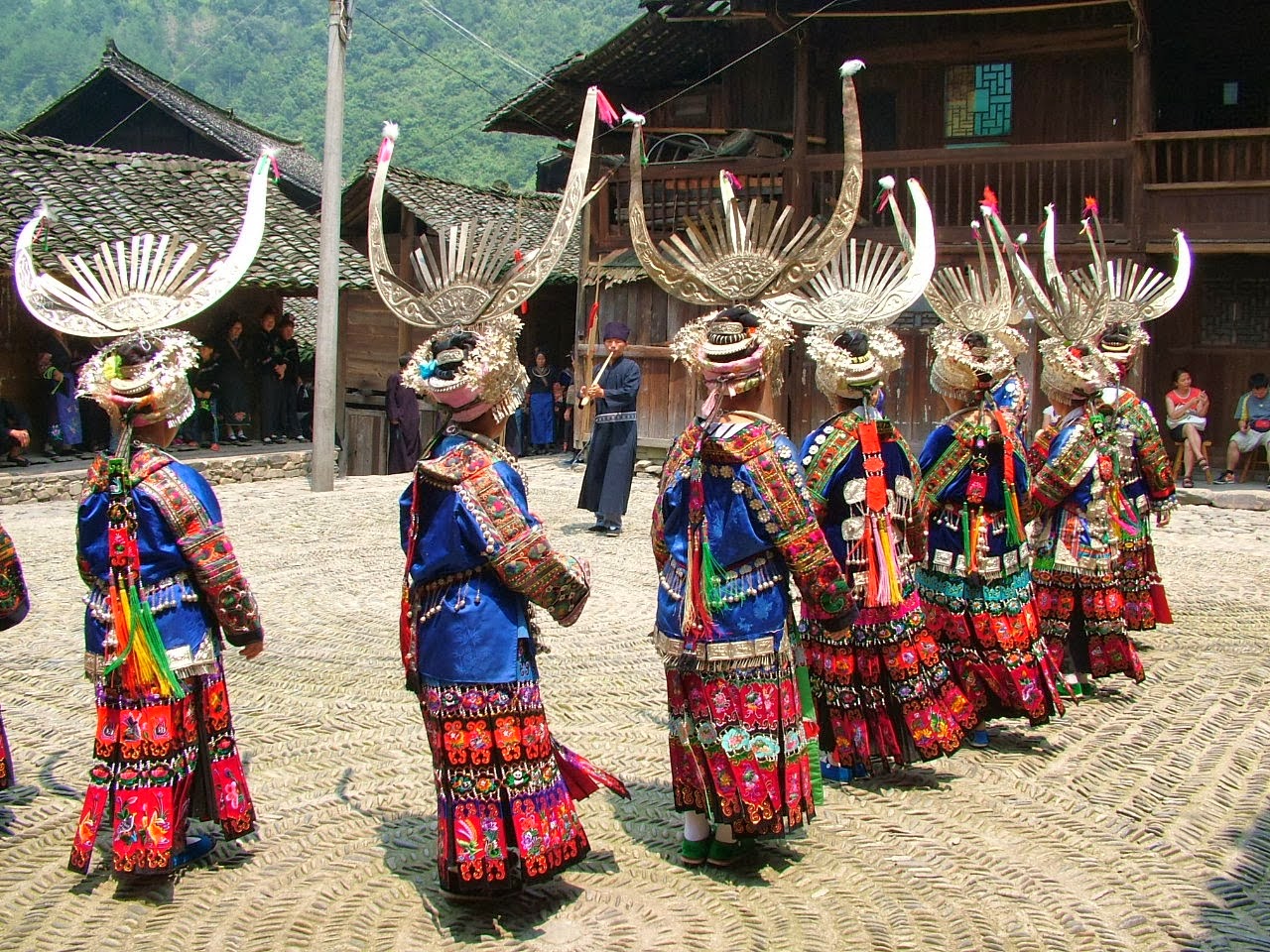
Wealth is also an aspect of festival attire, as in some cultures plates of silver, or metal coins are sewn directly to the clothes as a brash, and obvious statement of status. In Russia, clothes are heavily adorned with pearls, and especial the headdress know as a kokoshnik was sometimes entirely covered with pearls, and jewels. In the Guizhou, in the village of Upper Jidao the women wear these astonishing silver plated headdresses during festival dancing.
China
Russian Dancer Anna Pavlova in a Kokoshnik
Upper Jidao Village Dancers
Wherever you go in our amazing world, whatever culture you visit, this is something you will be able to see and instantly understand. When we call ourselves to festival, we choose to live in a world of abundance and delight, regardless of what the harsher realities of our lives may insist upon.
Kwanzaa Festival
It stands, (for me) as one of the ways we show our indefatigable spirit as a species. I find that both comforting, and wonderful in these often difficult times. No matter what else may portend, we find time and space to rejoice.
Ghana
Peru
Swazi Reed Dance Festival
Second is abundance, often in the form of volume, but also often in lush embroideries and decorative details.
Spain
Montenegro
Poland
Third is a sense of joy. There is a common thread, (you should pardon the pun) that runs through the attire of festival clothing the world over, and that is an aspect of visual delight, and playfulness. No matter the seriousness of the occasion, there is an underlying gleefulness that is inescapable.
Wodaabe Men
In Europe and most of the rest of the Western world, traditional festival attire is heavily embroidered in multiple colors, and the various shirts, skirts, vests and pants are often handed down generationally, since they are both family keepsakes, and also the product of possibly thousands of hours of loving work. This is especially true of places where life is often harsh because of the climate. Long months shuttered indoors away from icy winds and snow leave hands with time to spare, and it was both a way to while away hours, and also to keep a lighter attitude, working on something bright colored and happy in the dimness of winter.
Wealth is also an aspect of festival attire, as in some cultures plates of silver, or metal coins are sewn directly to the clothes as a brash, and obvious statement of status. In Russia, clothes are heavily adorned with pearls, and especial the headdress know as a kokoshnik was sometimes entirely covered with pearls, and jewels. In the Guizhou, in the village of Upper Jidao the women wear these astonishing silver plated headdresses during festival dancing.
China
Upper Jidao Village Dancers
Wherever you go in our amazing world, whatever culture you visit, this is something you will be able to see and instantly understand. When we call ourselves to festival, we choose to live in a world of abundance and delight, regardless of what the harsher realities of our lives may insist upon.
Kwanzaa Festival
It stands, (for me) as one of the ways we show our indefatigable spirit as a species. I find that both comforting, and wonderful in these often difficult times. No matter what else may portend, we find time and space to rejoice.
Wednesday, May 21, 2014
Tuesday, May 20, 2014
Why Styling?
Clients viewing clothes in Worth's Salon
Also, clients came to a fashion house and were shown the clothes on models, whenever they wished to see them. Of course, the notion of a fashion show, where clients and press were invited to a special event when a new collection would be produced, was still a ways off. In fact, the notion of fully seasonal collections was still unborn. Though all the couturiers produced clothes for the major seasons, new work as prepared and shown all the time.
The first official fashion shows were staged in department stores, like Ehrlich Brothers, which is credited with the first American fashion show in 1903. The trend quickly spread all over the retailing industry, and soon fashion shows were happening everywhere. But the couturiers were still showing their clothes privately to clients whenever they wished to see them, rather than staging full fashion shows.
It was probably Paul Poiret who did the first fashion parades, innovator that he was. He even did early movie footage of his models showing the current offerings of his house. The clothes were shown fully accessorized, but the accessories were not in any way exaggerated, they were meant to complete a look a client could carry out into the world confidently. Of course in most cases all those accessories were available at the self same fashion house, should madam wish to purchase them as well.
Paul Poiret clothes modeled in the garden at his home in Paris.
It wasn't till the 1960's amid the Youthquake which changed everything about how fashion got done, that special accessories and wild hair fashions that were never intended for real world usage began to appear on runways. Prior to that time couture fashion models wore their hair simply, they were all wearing the same basic shoe, and were often devoid of jewelry as well. Such things were thought to be a distraction from the clothes themselves.
As the marketing of accessory items became more and more important to the health and visibility of a couture establishment the number, variety and outlandishness of them increased as well. Similarly, in the ever more strident and far reaching popular culture, the need to gain the attention of an over stimulated populace encouraged designers to start staging expensive and lavish seasonal shows.
Chanel Fall/Winter 2011 show
This trend has continued to the point where it is far more unusual to see a show that is bare of such things as specialized lighting, set pieces and customized special effects. And the cost of these amazing shows can soar into the millions. First is the cost of the clothes themselves which range in price from thousands to hundreds of thousands of dollars each. Most couture presentations have around 40 to 60 individual looks, each of which must be accessorized. The models must be paid. There are lighting techs, sound people, set designers, props people and an army of make up, hair and wardrobe folk who make sure the models are perfect, all of whom get a paycheck. Beyond that is the pre-show advertizing and the inevitable bags of swag to be presented to the patrons, front row bags are very expensive bundles of free stuff, I assure you, but everyone going to a couture show, comes away with a bag full of goodies. All of it costs money and only increases the need for maximum impact and press for the show.
Louis Vuitton Fall/Winter 2012 show with a custom locomotive.
When you understand that a typical Couture fashion show is from 10 to 15 minutes long, this makes these shows the most lavish theatrical productions in the world. Only the half time show for the Superbowl can boast this level of expenditure.
So why the apparent need to crazy hair, make up and accessories? Why include unwearable shoes insane hats and headgear that would make a show girl raise an eyebrow? All to get, and hold our attention.
Our world has become one trudging through a miasma or information, of which, to be honest, this blog is a part. In order to gain notice, something big, loud and extraordinary must happen. So, couture is rising to that by not only creating breathtaking spectacles, but by presenting ever more impressively outre' looks for us to get inspired by.
Make no mistake, the couture industry does not survive on the sale of these clothes. Those days are long past. What makes a couture business truly successful is all the extras. The hats, shoes, belts, bags, scarves, sweaters, wallets, watches and scents are what drive this multi-billion dollar enterprise.
Jean Paul Gaultier accessories
Monday, May 19, 2014
Moving Forward, Looking Back
Repeatedly through our history the Attire language has surged into a new phase of expressions, by not only dropping the colloquialisms of the prior era, but by looking backwards to another age.
The first time in Western culture that we can see this with any clarity is the relaxation of shape and ornament that occurred after the change from the Reformation to the Restoration in England in the 1660s. Overnight the dour and subdued shapes and styles of the Reformation, with its Puritan ethics, were swept aside to be replaced by softer, looser, and far more frankly sexy clothes for both genders. But the salient point in this discussion is that the inspiration for this change was drawn from the classical world and its surviving art.
Portrait of Actress Nell Gwynne By Peter Lely
Mixed media portrait of Actress Nell Gwynne by George Stuart
It is surely difficult for us, from our distance, to be able to understand how it made itself known in manners of dress. But mostly it was in a desire for looser, more easily draped and fitted clothing. No one could ever look at the garments of classical Greece and equate them with mid 17th century English attire, but the people of that day could, and did. For them, the addition of draping that was not rigidly structured was enough to evoke that earlier day.
And the notion of referencing a previous age was not unknown in Fashion. Court masques had routinely called up their versions of ancient apparel to costume the folk who played around in those entertainments. So it wasn't much of a stretch for it to filter into more widely known clothing styles.
Masque costumes by Bountalenti
The next time we made a real forward movement was the period before, during, and after the French Revolution. While Marie Antoinette was on the throne, she championed the simplifying of dress in her later days, while she clung to the teachings of Rousseau. Though the French people chose to deride her for it, saying she was denying people livings by such simplicity; she, oddly, presaged the very styles that would come to symbolize the revolution. During the revolutionary period, a relentless removal of furbelows and ornament created a timeless sense to the clothes being worn. And immediately after the revolution, clothes acquired a look that came as close to realizing the Greco-Roman past as any ever devised. Women were seen walking in Paris in midwinter, clad in sheer muslin dresses, devoid of decoration, with only thin soled slippers and a shawl to protect them from the often fierce Gallic winter.
(You will have noticed that I'm not speaking of the men's clothes. I cannot in this instance, because men's styles had already begun that long process of ossification that resulted in the dim, sad shape and palette for suits we now have for men.)
Before the end of the 19th century Dress Reformers and the Aesthetic movement tried, with partial success, to move the conversation forward again. And again the past was the source of inspiration. This time though, it was the Medieval Era that took the stage. "Greenery yellery" clothes dyed in natural dyes and devoid of corseting, began to be worn by women of style, and with enough social status to step aside any strictures of propriety. Dresses made with long hanging dagged sleeves, and high waists recalling the illuminations of the Duc Du Barrys Book of Hours became a fashion to be dealt with. No, it didn't make a huge impact at the time, but it did set the stage for what was to come in the 20th century.
William Powell Frith- A Private View At the Royal Academy-1881
Purple velvet Aesthetic movement tea gown
Once the clock ticked over to 1900 things changed with an increasing rapidity, that has yet to falter. By 1910, super stylish women were wearing bifurcated dresses, with hemlines that exposed the ankles. This may seem silly to us, but remember, prior to this time dresses hit the floor and ankles were hardly ever seen. So they therefore gained considerable allure for their rarity.
The 1930s, with the Great Depression saw another return to classicism, with the bias cut evening dress so very often referring to the ancient world, and in particular the work of Madame Gres, whose tightly gathered silk crepe gowns are still the visual definition of goddess dresses.
The post war era saw us moving forward again by looking back, when Dior tried to recall the 19th century with his abundant and prodigiously womanly clothes.
The later 60s and 70s saw us drawing strongly from the 20s 30s and 40s in an effort to break with what was precieved as a too strong connection to a narrow stylish vocabulary. We were, as a culture, attempting to embrace for the first time, a true world Attire language. We failed, by the way.
And ever since then there has not been a single collection year that hasn't taken a good deal of its overall look from some other time.
Dolce Gabbana Byzantine inspired collection F/W 2013
We move forward, by looking back. Sure, we draw inspirations from the past, and one can say with authority that we should look to the future; but the future without reference to the past is a dangerous, and ill-informed place. Its not a place I want to be, myself. We gain so very much by looking back; not to live there, but we get perspective and context that aids us in facing the challenges of a new day.
The first time in Western culture that we can see this with any clarity is the relaxation of shape and ornament that occurred after the change from the Reformation to the Restoration in England in the 1660s. Overnight the dour and subdued shapes and styles of the Reformation, with its Puritan ethics, were swept aside to be replaced by softer, looser, and far more frankly sexy clothes for both genders. But the salient point in this discussion is that the inspiration for this change was drawn from the classical world and its surviving art.
Portrait of Actress Nell Gwynne By Peter Lely
Mixed media portrait of Actress Nell Gwynne by George Stuart
It is surely difficult for us, from our distance, to be able to understand how it made itself known in manners of dress. But mostly it was in a desire for looser, more easily draped and fitted clothing. No one could ever look at the garments of classical Greece and equate them with mid 17th century English attire, but the people of that day could, and did. For them, the addition of draping that was not rigidly structured was enough to evoke that earlier day.
And the notion of referencing a previous age was not unknown in Fashion. Court masques had routinely called up their versions of ancient apparel to costume the folk who played around in those entertainments. So it wasn't much of a stretch for it to filter into more widely known clothing styles.
Masque costumes by Bountalenti
The next time we made a real forward movement was the period before, during, and after the French Revolution. While Marie Antoinette was on the throne, she championed the simplifying of dress in her later days, while she clung to the teachings of Rousseau. Though the French people chose to deride her for it, saying she was denying people livings by such simplicity; she, oddly, presaged the very styles that would come to symbolize the revolution. During the revolutionary period, a relentless removal of furbelows and ornament created a timeless sense to the clothes being worn. And immediately after the revolution, clothes acquired a look that came as close to realizing the Greco-Roman past as any ever devised. Women were seen walking in Paris in midwinter, clad in sheer muslin dresses, devoid of decoration, with only thin soled slippers and a shawl to protect them from the often fierce Gallic winter.
(You will have noticed that I'm not speaking of the men's clothes. I cannot in this instance, because men's styles had already begun that long process of ossification that resulted in the dim, sad shape and palette for suits we now have for men.)
Before the end of the 19th century Dress Reformers and the Aesthetic movement tried, with partial success, to move the conversation forward again. And again the past was the source of inspiration. This time though, it was the Medieval Era that took the stage. "Greenery yellery" clothes dyed in natural dyes and devoid of corseting, began to be worn by women of style, and with enough social status to step aside any strictures of propriety. Dresses made with long hanging dagged sleeves, and high waists recalling the illuminations of the Duc Du Barrys Book of Hours became a fashion to be dealt with. No, it didn't make a huge impact at the time, but it did set the stage for what was to come in the 20th century.
William Powell Frith- A Private View At the Royal Academy-1881
Purple velvet Aesthetic movement tea gown
Once the clock ticked over to 1900 things changed with an increasing rapidity, that has yet to falter. By 1910, super stylish women were wearing bifurcated dresses, with hemlines that exposed the ankles. This may seem silly to us, but remember, prior to this time dresses hit the floor and ankles were hardly ever seen. So they therefore gained considerable allure for their rarity.
The 1930s, with the Great Depression saw another return to classicism, with the bias cut evening dress so very often referring to the ancient world, and in particular the work of Madame Gres, whose tightly gathered silk crepe gowns are still the visual definition of goddess dresses.
The post war era saw us moving forward again by looking back, when Dior tried to recall the 19th century with his abundant and prodigiously womanly clothes.
The later 60s and 70s saw us drawing strongly from the 20s 30s and 40s in an effort to break with what was precieved as a too strong connection to a narrow stylish vocabulary. We were, as a culture, attempting to embrace for the first time, a true world Attire language. We failed, by the way.
And ever since then there has not been a single collection year that hasn't taken a good deal of its overall look from some other time.
Dolce Gabbana Byzantine inspired collection F/W 2013
We move forward, by looking back. Sure, we draw inspirations from the past, and one can say with authority that we should look to the future; but the future without reference to the past is a dangerous, and ill-informed place. Its not a place I want to be, myself. We gain so very much by looking back; not to live there, but we get perspective and context that aids us in facing the challenges of a new day.
Subscribe to:
Posts (Atom)


.jpg)