We start forming our own battery of likes and dislikes from the moment we pop out into the world. As soon as our eyes open, and we can see with clarity, we begin piling things into, things I like, and things I don't like. At first, this is good enough; the simple black and white of absolutism. But in short order, those two polar opposites in our minds divide, divide again, and yet again, until many years later, we have our own personal, fully formed organism of preferences.
How this refers to the Attire language and its usage is simple, we bring all of those preferences to the table each time we think of adding to our vocabulary of apparel.
In our very early lives, we are most of us hamstrung in that to a major degree, since our clothing choices are being dictated by our parents. They not only select the clothes we wear because they pay for them, but because they believe that their choices will be better ones, and no doubt to a significant degree, they are. They can select the correct size, and make sure the quality level will at least last to the next growth spurt. What they cannot do with accuracy though, is see into our little minds and know what we would prefer to wear, given the free choice.
So, our earliest free choices tend to be pretty out there in terms of style, color and practicality. Given our first free rein, we, most of us at any rate, choose things that are more emphatically stylish, more boldly colored or patterned, and aren't especially practical in the long term sense.
As we enter our teen years, our choices continue to evolve, growing more reasoned as we begin to learn the subtleties of things like fit and make. As well, our style choices take another turn too, since our internal growth into adulthood, expresses itself outwardly. We both consciously, and unconsciously, often choose clothing that will make us seem more adult than we in fact are, because we want to hurry the day when we will be free to move about in the world, without parental constraints.
Once the bounds of parental control get cut, things change dramatically. The chief reason, beyond our actual freedom to choose for ourselves without regard to another whims, is that we are paying for those things on our own, and so considerations of budget, and long term wearability gain more importance to us in our choices. Its during this period of young adulthood that we really finalize our approach to how we dress ourselves.
There are those whose career choice makes them be quite decided in how they differentiate between their work and other lives. Many is the person I know whose work garb is never used after 5 or on weekends. Others have a much less defined line between work and non-work apparel, and some, none whatever.
For myself, the line is pretty murky, since I work in a very casual environment, so there are few things I own that are really not ever worn to work. And this fact has affected the overall expression of my own Attire dialect.
During our middle years, and by that I mean the mid 30s to the 60s, we tend to be the most attached to style and its expressions.
As we transition into our elder years, we tend to choose less overtly stylish clothes, opting for comfort over fashionability. Part of that is that so much of what is produced is aimed at the young market, and what is being made for more mature people tends to be more conservative. So, rather than fight that we allow our attire to change again. Of course, its important to note as well that as we get older, the vast majority of us end up living on smaller, and entirely fixed incomes, so budgetary concerns become a very big player in every choice we make.
So what we have here, in the over arching sense of it, is a method of scrolling through our lives, and looking at the arc of our progression in terms of apparel. When we look at those things again, through the lens of our accumulated years we can, if we wish, gain some very real insight into who we were, and what we dreamed at the time, and with that get a clearer picture of the totality of our path.
Sunday, September 14, 2014
Saturday, September 13, 2014
Scatter #21
Ahhhhhh, Saturday! And we all know what that means. Time again for a stroll through my far too crowded noggin.
This marvelous and perfectly executed work is part of a historical recreation done by Olivier Henry in 2005, and recently used as part of an exhibition of historical clothing in France. The beadwork and embroidery are simply perfect in every detail, and the subtle balance of colors is both soothing and exciting at once. Bravo, Monsieur!
I have written and spoken before about how we started on this long path towards the frightfully complex language we now have to hand. Here is an ideal example of what may be the very earliest kind of human adornment. Taking the very substance of the land and painting it onto our skin in patterns seems a very logical place for all this to have begun, and its still a powerful method of conveying our needed messages. What does this pattern say to you, as a modern world person?
A bit of frightfully dazzling bling next. This breathtaking brooch is the product of Tiffany & Co. its a 75.47 carat square cut emerald called the Hooker emerald, mounted in platinum, with 108 round cut diamonds. The raw emerald was first mined in Colombia in the 16th or 17th century. It passed from the Spanish to the ottoman empire then to Paris, where it was eventually bought at auction by Tiffany & Co. First set by Tiffany in a tiara, it sat, unsold, till it was re-set in the 1950s as a brooch and subsequently purchased by Janet Annenburg Hooker, who eventually gifted it to the Smithsonian.
This next is guaranteed to make y'all go WTF? The work for design company Skingraft is always on the edge, seriously challenging, and often more than a bit disturbing. This menswear ensemble from their S/S 2015 collection is no less of any of that. The quilted coat, with its lightened center, makes me think of someone being dissected. And the fact that its shiny as well only heightens that literally visceral quality in my eyes. Sometimes, even for me, finding the things within avant garde looks that communicate well is tough.
The 1920s was the first decade where pants for women gained enough credibility to leave the realm of the edgy and make the leap into the mainstream of the Attire dialog. This at home pajama of lace and lame' is perhaps a rather silly example to our 21st century eyes. But it was full on fashionable at the time. And recalls to me as well, a post I did encouraging us all to take better care of our inner selves by dressing up when we relax. Honor yourself at home, in private. Wear something fabulous.
With many thanks to the Leather Archive and Museum, this really rather silly advert for leather pants from the 1970s. We start out with that classic, yet absurd men's clothing ad pose, the one no man on earth would every do naturally. And then the rather jarring dissonance between the snakeskin boots and leather pants, and the beige sweater vest and necktie above the waist. I don't remember ever seeing anyone togged out like this. Do you?
More great human artistry. This is a Venetian carnivale mask. Our innate need to transmogrify ourselves into people than things outside of the normal has roots as far back as our walking upright. This fantastical mask allows its wearer to take on, literally, the aspect of some kind of imagined animal. Dressing up in this way releases something primal in us. It gives us a chance to voice things we normally suppress. What would you reveal, with this on?
With a very few exceptions for over a century lace has been the exclusive province of women. To my mind the motivator behind that was the changes wrought by the Industrial Revolution. Men were required to present a far more serious face to the world, and lace was entirely to fragile a thing to be part of that newly grim visage. As we move more into the 21st, our notions of male and female, and of gender appropriateness in apparel are getting more consistently challenged. This ensemble by Jean Paul Gaultier is just such a challenge. Rendered as a tee shirt, the lace becomes a new expression: and paired with leather opera gloves, that statement gains considerable, though in some ways difficult to accept, power.
This fashion illustration from 1799 shows one of the truly strange transitional silhouettes to ever unfortunately grace women's bodies. The 18th century was known for the vast proportions of the skirts, and at the end of the century, in an effort to retain some separation from common dress, while giving a nod to the new mode, this ill-considered thing appeared. What happened was this: the waistline was rapidly rising to just under the bust. with the concomitant flattening of the skirts into a soft tube. The court dress allowed the waistline to rise, but kept the huge skirts anyway, establishing a look that made women resemble a tea cozy with arms. This fashion was mercifully short lived.
To close out today, this fab looking fella. Give your inner dandy room to play. Find ways to bring it out to the world. This marvelous fellow is working his dandy wonderfully. And doesn't he know it?
Have a wonderful weekend my friends!
This marvelous and perfectly executed work is part of a historical recreation done by Olivier Henry in 2005, and recently used as part of an exhibition of historical clothing in France. The beadwork and embroidery are simply perfect in every detail, and the subtle balance of colors is both soothing and exciting at once. Bravo, Monsieur!
I have written and spoken before about how we started on this long path towards the frightfully complex language we now have to hand. Here is an ideal example of what may be the very earliest kind of human adornment. Taking the very substance of the land and painting it onto our skin in patterns seems a very logical place for all this to have begun, and its still a powerful method of conveying our needed messages. What does this pattern say to you, as a modern world person?
A bit of frightfully dazzling bling next. This breathtaking brooch is the product of Tiffany & Co. its a 75.47 carat square cut emerald called the Hooker emerald, mounted in platinum, with 108 round cut diamonds. The raw emerald was first mined in Colombia in the 16th or 17th century. It passed from the Spanish to the ottoman empire then to Paris, where it was eventually bought at auction by Tiffany & Co. First set by Tiffany in a tiara, it sat, unsold, till it was re-set in the 1950s as a brooch and subsequently purchased by Janet Annenburg Hooker, who eventually gifted it to the Smithsonian.
This next is guaranteed to make y'all go WTF? The work for design company Skingraft is always on the edge, seriously challenging, and often more than a bit disturbing. This menswear ensemble from their S/S 2015 collection is no less of any of that. The quilted coat, with its lightened center, makes me think of someone being dissected. And the fact that its shiny as well only heightens that literally visceral quality in my eyes. Sometimes, even for me, finding the things within avant garde looks that communicate well is tough.
The 1920s was the first decade where pants for women gained enough credibility to leave the realm of the edgy and make the leap into the mainstream of the Attire dialog. This at home pajama of lace and lame' is perhaps a rather silly example to our 21st century eyes. But it was full on fashionable at the time. And recalls to me as well, a post I did encouraging us all to take better care of our inner selves by dressing up when we relax. Honor yourself at home, in private. Wear something fabulous.
With many thanks to the Leather Archive and Museum, this really rather silly advert for leather pants from the 1970s. We start out with that classic, yet absurd men's clothing ad pose, the one no man on earth would every do naturally. And then the rather jarring dissonance between the snakeskin boots and leather pants, and the beige sweater vest and necktie above the waist. I don't remember ever seeing anyone togged out like this. Do you?
More great human artistry. This is a Venetian carnivale mask. Our innate need to transmogrify ourselves into people than things outside of the normal has roots as far back as our walking upright. This fantastical mask allows its wearer to take on, literally, the aspect of some kind of imagined animal. Dressing up in this way releases something primal in us. It gives us a chance to voice things we normally suppress. What would you reveal, with this on?
With a very few exceptions for over a century lace has been the exclusive province of women. To my mind the motivator behind that was the changes wrought by the Industrial Revolution. Men were required to present a far more serious face to the world, and lace was entirely to fragile a thing to be part of that newly grim visage. As we move more into the 21st, our notions of male and female, and of gender appropriateness in apparel are getting more consistently challenged. This ensemble by Jean Paul Gaultier is just such a challenge. Rendered as a tee shirt, the lace becomes a new expression: and paired with leather opera gloves, that statement gains considerable, though in some ways difficult to accept, power.
This fashion illustration from 1799 shows one of the truly strange transitional silhouettes to ever unfortunately grace women's bodies. The 18th century was known for the vast proportions of the skirts, and at the end of the century, in an effort to retain some separation from common dress, while giving a nod to the new mode, this ill-considered thing appeared. What happened was this: the waistline was rapidly rising to just under the bust. with the concomitant flattening of the skirts into a soft tube. The court dress allowed the waistline to rise, but kept the huge skirts anyway, establishing a look that made women resemble a tea cozy with arms. This fashion was mercifully short lived.
To close out today, this fab looking fella. Give your inner dandy room to play. Find ways to bring it out to the world. This marvelous fellow is working his dandy wonderfully. And doesn't he know it?
Have a wonderful weekend my friends!
Friday, September 12, 2014
Thursday, September 11, 2014
A Natural Elegance
Most people would consider the 1930s to be one of the most flattering eras of the 20th century, for women in especial.
Why is that, actually? It was a time of serious deprivation for many, as the Great Depression rolled along. But the clothes that were being constructed and worn are still, 80+ years later, lionized as some of the most well considered ever. The reasons are multiple.
The first and most important is that the clothing never forgot what the actual shape and proportions of a woman's body really were. The waistline was at its natural point. The bust, hips and shoulder-line were not exaggerated extremely. So a woman of any shape and size could be attractive in that clothing.
The second reason was a logical progression from the 1920s. During the 20s, the effervescent quality of the youthful fashions helped to express a greater sexual freedom; and freedom in other activities as well, like sport, and business.
While the seriousness of the Depression did cause a lengthening of hems and a more mature mien to take center stage, the sexuality present in the prior decades clothes continued, and was even more frankly expressed, through ubiquitous bias cut evening wear, often backless, and worn with scant underclothes.
The third reason refers to the seriousness I mentioned a moment ago. For the first time ever, really, due to financial privations, a woman was a part of the workforce in vastly great numbers. Their working clothes needed to be comfortable, practical, and also attractive. The level of sexual attraction needed to be very subtle, so as not to rouse suspicions of being "fast". And that need for quietly compelling clothing expressed all across the fashion world, at every level. It created a mature, knowingly expressed sexuality. It helped to create, possibly for the first time, a full fledged image of a woman in control of her life and world.
So, its natural, I believe that we routinely go back to the thirties for inspiration. The clothes did everything they should do, but with taste, class, and subtlety.
And that, is something a whole lot of people want to achieve.
Why is that, actually? It was a time of serious deprivation for many, as the Great Depression rolled along. But the clothes that were being constructed and worn are still, 80+ years later, lionized as some of the most well considered ever. The reasons are multiple.
The first and most important is that the clothing never forgot what the actual shape and proportions of a woman's body really were. The waistline was at its natural point. The bust, hips and shoulder-line were not exaggerated extremely. So a woman of any shape and size could be attractive in that clothing.
The second reason was a logical progression from the 1920s. During the 20s, the effervescent quality of the youthful fashions helped to express a greater sexual freedom; and freedom in other activities as well, like sport, and business.
While the seriousness of the Depression did cause a lengthening of hems and a more mature mien to take center stage, the sexuality present in the prior decades clothes continued, and was even more frankly expressed, through ubiquitous bias cut evening wear, often backless, and worn with scant underclothes.
The third reason refers to the seriousness I mentioned a moment ago. For the first time ever, really, due to financial privations, a woman was a part of the workforce in vastly great numbers. Their working clothes needed to be comfortable, practical, and also attractive. The level of sexual attraction needed to be very subtle, so as not to rouse suspicions of being "fast". And that need for quietly compelling clothing expressed all across the fashion world, at every level. It created a mature, knowingly expressed sexuality. It helped to create, possibly for the first time, a full fledged image of a woman in control of her life and world.
So, its natural, I believe that we routinely go back to the thirties for inspiration. The clothes did everything they should do, but with taste, class, and subtlety.
And that, is something a whole lot of people want to achieve.
Wednesday, September 10, 2014
Visual Glossolalia
In any language it is possible for meaning to get garbled, or completely lost, through there being too many, or misused words in the communication. This kind of thing most often makes itself apparent in the Attire language with the use of garments and accessories which do not harmonize with each other. By that I mean, when we don apparel that is not intended to be used in context with other garments we have on. If for example someone were to be seen wearing a sari, with a football jersey over it and a tam-o-shanter hat, we would be puzzled, and rightly so. In fact, we might be so confused by what we are looking at that we might impute that the wearer is not in their right mind.
The reason I'm bringing this subject up, is because I've been talking so much of late about the growing global village, and how, with access to influences and clothing from nearly every culture on earth, we are not only vastly expanding our vocabulary, but also exposing ourselves to a case of visual glossolalia.
Harmonious communication, effective communication in the apparel dialog, relies on a few basic concepts to work: fit, shape, color, texture, pattern, and function. These factors all need to relate to each other in some way. If one of these things is uniform throughout an ensemble, then it is likely to work. And of course, disparities can often be appealing, invigorating additions to a sartorial sentence; giving that final emphasis that makes it all clear to the viewer.
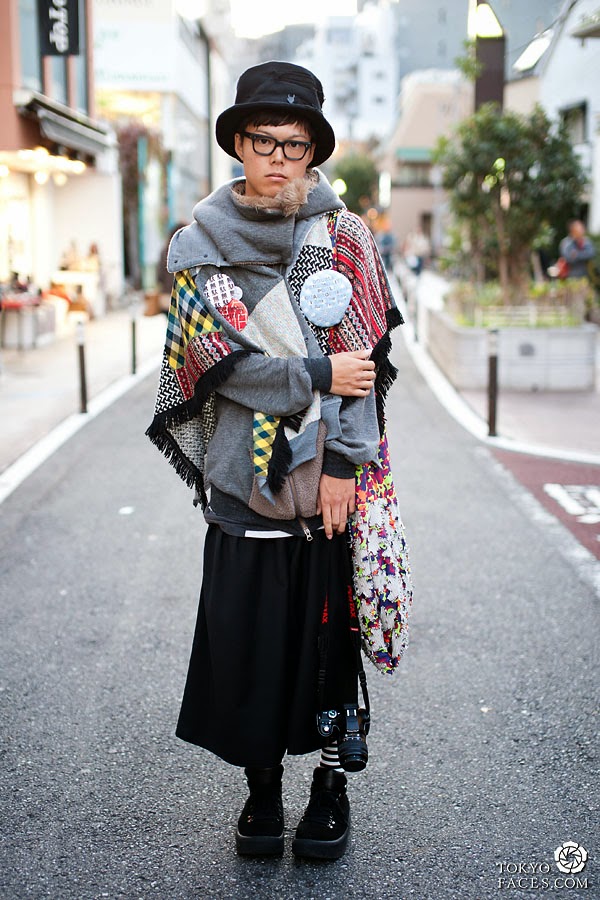
As a series of examples of well handled inter-cultural expression, looking at the street styles of Tokyo is very helpful. Recently, young people in Japan have developed a mania for American retro clothing, and so, second hand stores all over the United States have been scoured for good clothes to take back and use there. What they are doing is unique in terms of how they pair things, and the visual balances they create. The number of cultural influences in play is vast.
On the other hand its actually the design community which is presenting the most egregiously yammering, overwrought, and unintelligible visual sentences. The current vogue for wildly jarring styling with accessories, takes ensembles that often, of themselves, are fine; and clearly comprehensible, turning them into gibberish.
How this relates to all of us, is that we are being exposed more and more often to deliberately opposed choices; and when handled by people with training or an artful eye, it can be done effectively.
For most of us, its too complex to get clear on. So we run the risk of turning whatever statement we are attempting to make into something that will make viewers wonder at what we are trying to convey.
But, should this be an active deterrent? No, not in the least degree. Its important to try new words in your sartorial vocabulary; and if you misuse them now and again, well, its a learning process. So go ahead and try out that crazy hat, or those edgier shoes, or that brightly colored coat. No one speaks perfectly clearly all the time. So relax, and get in there and start talking Attire!
The reason I'm bringing this subject up, is because I've been talking so much of late about the growing global village, and how, with access to influences and clothing from nearly every culture on earth, we are not only vastly expanding our vocabulary, but also exposing ourselves to a case of visual glossolalia.
Harmonious communication, effective communication in the apparel dialog, relies on a few basic concepts to work: fit, shape, color, texture, pattern, and function. These factors all need to relate to each other in some way. If one of these things is uniform throughout an ensemble, then it is likely to work. And of course, disparities can often be appealing, invigorating additions to a sartorial sentence; giving that final emphasis that makes it all clear to the viewer.
As a series of examples of well handled inter-cultural expression, looking at the street styles of Tokyo is very helpful. Recently, young people in Japan have developed a mania for American retro clothing, and so, second hand stores all over the United States have been scoured for good clothes to take back and use there. What they are doing is unique in terms of how they pair things, and the visual balances they create. The number of cultural influences in play is vast.
On the other hand its actually the design community which is presenting the most egregiously yammering, overwrought, and unintelligible visual sentences. The current vogue for wildly jarring styling with accessories, takes ensembles that often, of themselves, are fine; and clearly comprehensible, turning them into gibberish.
How this relates to all of us, is that we are being exposed more and more often to deliberately opposed choices; and when handled by people with training or an artful eye, it can be done effectively.
For most of us, its too complex to get clear on. So we run the risk of turning whatever statement we are attempting to make into something that will make viewers wonder at what we are trying to convey.
But, should this be an active deterrent? No, not in the least degree. Its important to try new words in your sartorial vocabulary; and if you misuse them now and again, well, its a learning process. So go ahead and try out that crazy hat, or those edgier shoes, or that brightly colored coat. No one speaks perfectly clearly all the time. So relax, and get in there and start talking Attire!
Tuesday, September 9, 2014
In Praise Of Jewels
Amboseli Man of Kenya
And over millennia of time we have become ever more sophisticated with regard to the techniques and skill we bring to this incredibly old artform. That we have in the process despoiled the land and sometimes mortally harmed each other in the trek to find the rare, colorful, and shiny things we have made into our jewels, is not to be disputed. We have, and continue to do so, with little thought to the how and why. And so our quest for bright adornment is also bloodied and dark.
Garrard&Co. The Cullinan Diamond Brooch But the subject here is the simple, and often not so simple beauty that we have created from these things we choose to treasure. For, doubt it not, gemstones have no value whatever in and of themselves. They are merely rock crystals of varied composition, nothing more. The same can be said for gold, silver and platinum, which apart from jewelry, have only slight real world usage.
Like hats and headdresses, jewelry can, and does often lift to the arena of art; transcending time, and place, becoming in the process something fraught with history, and subtly layered meanings.
So lets just take a good look at a wide range of jewelry from far places and near. Sure, its important to never forget the loss and suffering that hides within so much of this dazzlement, but it does not remove its objective loveliness.
Late Egyptian gold falcon pectoral with glass inlay. After 600 BC
Diamond and Citrine crown of Queen Sirikrit of Thailand
16th century Italian agate cameo portrait brooch with enamel work Roman cavalry helmet, gilded silver, between 23 and 319 AD
Robin Faye- Chalcopyrite necklace
Newari necklace, Nepal
Michele Dato, Necklace of St Januarius 1679 (added to repeatedly over years)
Jeweled pectoral, Oman Shell drop earrings, English, 1880
C.H. Meyla Deco diamond and enamel pendant brooch
Silver and gold cuff with faceted garnets, Turkoman
Sarmatian gold diadem with various precious stones. Russia, first century AD
Cartier-platinum set blue tourmaline, diamond and yellow sapphire earrings
Makara bangles, Tamil Nadu, India
Turquoise pendant, Tibet
Necklace, Morocco
If you had the choice of it, what sort of thing would you wear about your neck, or on your head, or anywhere else for that matter?
Subscribe to:
Posts (Atom)