Mkay, so, sorry it took me till now to get this to you. But it took a while to get my thoughts ordered about this. Another "serious" post, about personal responsibilty. something us 21st century folk seem to avoid like a plague.
Monday, September 8, 2014

Sunday, September 7, 2014
Our Responsibility
This one is a toughie. I admit it. It is a situation that effects every aspect of the Attire dialog as it is currently being used.
I've written and spoken before about the importance of our taking the time, and investing the energy, personally, into finding out how our clothes are produced, and where. Well, another aspect of this issue is what the clothes are made from. You see, the huge first growth forests of the world are continuing to shrink rapidly, and a huge part of why this is so, is the textile industry. Not only is the manufacture of fabric one of the chief polluters in the world, but the production of fibers like rayon, viscose, modal, and tencel are all largely made from wood pulp. And since we are, (lets just admit it, shall we?) addicted to the new and the fashionable, the industry drives forward cutting down more trees, seizing more land and in short hastening the day when we cannot turn back from the brink of eco-collapse. And its driven even faster by the current mania for all things bamboo. See, bamboo grows very fast, which is a good thing, in production terms, and it can grow in a wide variety of climates. Also a good thing. However, when amazon forests are denuded to make way for bamboo, so that we can have household goods, and on point with this discussion, textiles containing bamboo, we are not only skewing ecosystems that have been safely in place for millennia, but we are harming the peoples of those countries thinning out their access to things they have traditionally used themselves. All to fuel a desire to seem "green" by using something made with bamboo.
So, between the pulping of trees all over the world, to the over-planting of bamboo, we are narrowing the focus of the global ecosystem and very likely helping to create a scenario from which we cannot retreat in safety.
What am I asking for here? I'm not telling you to boycott, or stop shopping. I only ask of you this, when you do shop, don't ask for a bag, carry one of the doubtless many reusable ones you already have. Look at content labels carefully. And overall, think more about re-using, re-purposing and recycling what you do have.
And to sum up, one of the things that makes me so sad, and gives me real pause is that in a real sense, these materials we are talking about here are wise choices, because they are renewable resources; and being plant matter, they contribute to the health of the planet. What makes that a sad thing for me is that we have taken these things to a wild extreme in terms of production, and so are ending up doing much more harm, than good. So, its not about not using pulp or bamboo at all, but being far more prudent about when and how we do so.

And here, courtesy of one of our friends here and on FB, the link to an article about this.
www.ran.org/introducing_out_of_fashion_a_campaign_for_forest_friendly_fabrics
I've written and spoken before about the importance of our taking the time, and investing the energy, personally, into finding out how our clothes are produced, and where. Well, another aspect of this issue is what the clothes are made from. You see, the huge first growth forests of the world are continuing to shrink rapidly, and a huge part of why this is so, is the textile industry. Not only is the manufacture of fabric one of the chief polluters in the world, but the production of fibers like rayon, viscose, modal, and tencel are all largely made from wood pulp. And since we are, (lets just admit it, shall we?) addicted to the new and the fashionable, the industry drives forward cutting down more trees, seizing more land and in short hastening the day when we cannot turn back from the brink of eco-collapse. And its driven even faster by the current mania for all things bamboo. See, bamboo grows very fast, which is a good thing, in production terms, and it can grow in a wide variety of climates. Also a good thing. However, when amazon forests are denuded to make way for bamboo, so that we can have household goods, and on point with this discussion, textiles containing bamboo, we are not only skewing ecosystems that have been safely in place for millennia, but we are harming the peoples of those countries thinning out their access to things they have traditionally used themselves. All to fuel a desire to seem "green" by using something made with bamboo.
So, between the pulping of trees all over the world, to the over-planting of bamboo, we are narrowing the focus of the global ecosystem and very likely helping to create a scenario from which we cannot retreat in safety.
What am I asking for here? I'm not telling you to boycott, or stop shopping. I only ask of you this, when you do shop, don't ask for a bag, carry one of the doubtless many reusable ones you already have. Look at content labels carefully. And overall, think more about re-using, re-purposing and recycling what you do have.
And to sum up, one of the things that makes me so sad, and gives me real pause is that in a real sense, these materials we are talking about here are wise choices, because they are renewable resources; and being plant matter, they contribute to the health of the planet. What makes that a sad thing for me is that we have taken these things to a wild extreme in terms of production, and so are ending up doing much more harm, than good. So, its not about not using pulp or bamboo at all, but being far more prudent about when and how we do so.
And here, courtesy of one of our friends here and on FB, the link to an article about this.
www.ran.org/introducing_out_of_fashion_a_campaign_for_forest_friendly_fabrics
Saturday, September 6, 2014
Scatter #20
Well, weeks roll by fast and here we are at scatter time again.
This first image just made me smile so much. These 3 young ladies are supposedly awaiting their prom dates. What makes this worthy of comment though, is as an image of how we wish to represent ourselves in our youth now, as opposed to the 1950s. These young women all have very adult hairstyles, and their clothing is sweetly demure. In fact, all three dresses are virtually interchangeable, since they are all strapless sweetheart necklined, full skirted dresses. What shows up at proms now is short, tight and shiny to a significant degree. The desire to express full adulthood takes precedence now, over the more carefully controlled version we see here.
 Oh, you know me, I just gotta mess with you now and then. Hey, I have to make sure that you're paying attention. (grin) These two images are by photographer Alvaro Villarrubia. Both are intense images and both push buttons in extreme ways. We are challenged about sexuality, gender and our notions of reality. As well, the Attire sentences being expressed are far more complex that first glace might tell you. What do YOU see here?


In 1923 Revillon Furriers did this gloriously green velvet evening coat, trimmed in mink. Something about the slouchy easiness of this style implies that it must've been sexy as hell to wear. Imagine that collar slipping off the shoulder. Yep, sexy clothes, without being nasty. Plus the combination of that green with the tone of the fur is perfection.
 Men's hairstyles have been getting a push as much as men's clothes have of late. This is one especially out there, but beautiful example. Certainly this is not a statement every man could or should attempt to make, but on the right man, this is magical. With the current trend for longer hair, this could become a thing. I wonder.
 Model Roxanne Sanderson, photographed by Tiago Molinos for Spur. I love this coat. Sure you must be wee to not look like a yeti in it, but for the right person, this is a poetic statement. now those side pleated pants are something that could translate well for many a person, female and male. I would love to see them become a more regular part of the Attire language.
 This Kenzo coat is delicious. And its fake fur, if you wanna know. Fakes are getting REALLY good these days. I love the take on a typical denim jacket shape. Not much more here about this. I just like it a lot.
 This dress caught my eye and made me sigh. Its so rare these days that this sense of artfulness comes into play. Though the textile isn't hand painted, it reads that way due to the expert positioning of the pattern . It is very nearly lyrical in its expression. I could see this just as well being worn over pants or a long narrow skirt as see it as is. Loveliness.
 As a final entry, something truly wonderful. This medallion was made by Wedgewood and Sons in 1787, and designed for them by Willam Hackwood. The medallion was made to be worn by supporters of the anti-slavery cause. Abolitionists of both sexes wore them. Wedgewood himself is credited with the motto, "Am I not a man, and a brother?" that is on the medallion. It was never sold outright, nor listed in their catologs. Its understood that Wedgewood bore the entirety of the cost of them personally.

So, there's your Scatter for this week. I hope you enjoyed it!
This first image just made me smile so much. These 3 young ladies are supposedly awaiting their prom dates. What makes this worthy of comment though, is as an image of how we wish to represent ourselves in our youth now, as opposed to the 1950s. These young women all have very adult hairstyles, and their clothing is sweetly demure. In fact, all three dresses are virtually interchangeable, since they are all strapless sweetheart necklined, full skirted dresses. What shows up at proms now is short, tight and shiny to a significant degree. The desire to express full adulthood takes precedence now, over the more carefully controlled version we see here.
In 1923 Revillon Furriers did this gloriously green velvet evening coat, trimmed in mink. Something about the slouchy easiness of this style implies that it must've been sexy as hell to wear. Imagine that collar slipping off the shoulder. Yep, sexy clothes, without being nasty. Plus the combination of that green with the tone of the fur is perfection.
So, there's your Scatter for this week. I hope you enjoyed it!
Friday, September 5, 2014
Crowned With Many Crowns
I wanted to continue the conversation about hats and headgear by focusing on something particular. Without question, the single most iconic piece of headgear, the one that creates the strongest emotional and psychological response, is the crown.
 Crown of the Queen of Romania
Whether our reaction is one of delight, revulsion, anger or covetousness, we respond them instantly in a way we do not for any other type of thing we put on our heads. Our feelings of instant consonance, allegiance, or resistance are so long held, so deeply inborn, that we don't even acknowledge them on a conscious level. Now why is that?
My own thought on this connects to what I said in a prior post. The very first thing we did in our dim undocumented past, is put things we found beautiful or important on our heads. We did so to show we had conquered them if they were prey, and in some other way, some deeper, less obvious way, we put them on our heads to say that we understood them, and controlled them.
 And so, the concept of a crown meaning temporal sway over others was born. Sure, it began as a simple expression of domination over captured animals. It was also a form of sympathetic magic, allowing us to draw the power of some beast we had hunted into ourselves. Quickly it grew to mean an understanding and control over larger parts of the natural realm. And over the centuries, the crown, in whatever form it took, began to signify a complete understanding of the world both physical and spiritual. And connected to that, that all those viewing someone in a crown, must subjugate themselves to that person.
Part of what I find interesting is that it matters not one bit what a crown is made of. It can be wood, bone, feathers, stiffened hide or metal. In its manner of decoration it can be pure and simple, or insanely complex. None of this diminishes the impact, only the message changes a bit. A crown of feathers and hide evokes a different, but no less deep seated response in us, than a crown of beaten gold set with gemstones.
 And another point of significance is that a crown can gather history about it over time. Since crowns are most often made from long lasting of materials, which only adds to the subtext of power and permanence, the wearer is not only invested with whatever sway is conveyed by that particular crown, but also the influence of every other who has worn it. So again, there is another subtle sympathetic magic involved, though we wouldn't these days think of it in those terms.
 Crowns are such an old and well known part of the Attire language it is unlikely that we will ever stop using the word entirely. Though the vast number of us will never wear one in real terms, our understanding of them, and what they mean, goes past all our boundaries and social conventions. We know instantly that this person is elevated above the norm, and has some sort of special power, be it magical, religious, or temporal.
 They need not speak, themselves, because the Attire language is doing the talking for them.
Whether our reaction is one of delight, revulsion, anger or covetousness, we respond them instantly in a way we do not for any other type of thing we put on our heads. Our feelings of instant consonance, allegiance, or resistance are so long held, so deeply inborn, that we don't even acknowledge them on a conscious level. Now why is that?
My own thought on this connects to what I said in a prior post. The very first thing we did in our dim undocumented past, is put things we found beautiful or important on our heads. We did so to show we had conquered them if they were prey, and in some other way, some deeper, less obvious way, we put them on our heads to say that we understood them, and controlled them.
Part of what I find interesting is that it matters not one bit what a crown is made of. It can be wood, bone, feathers, stiffened hide or metal. In its manner of decoration it can be pure and simple, or insanely complex. None of this diminishes the impact, only the message changes a bit. A crown of feathers and hide evokes a different, but no less deep seated response in us, than a crown of beaten gold set with gemstones.
Thursday, September 4, 2014
Heady Notions
No accessory that we use routinely is as potent, varied and meaningful as the hat. Whether we need to protect ourselves, project power, sexuality and beauty, or proclaim allegiance to some group, it is a major player.
 Hats are far more than things we plop on to keep away the weather, they are wearable sculptures that give emphasis to our faces and command others to see us. Even when those same hats obscure and limit view, they have power and when used well, are nearly impossible to resist. We want the wearer to turn their head to us. We want to lift that veil, or push back that hood.
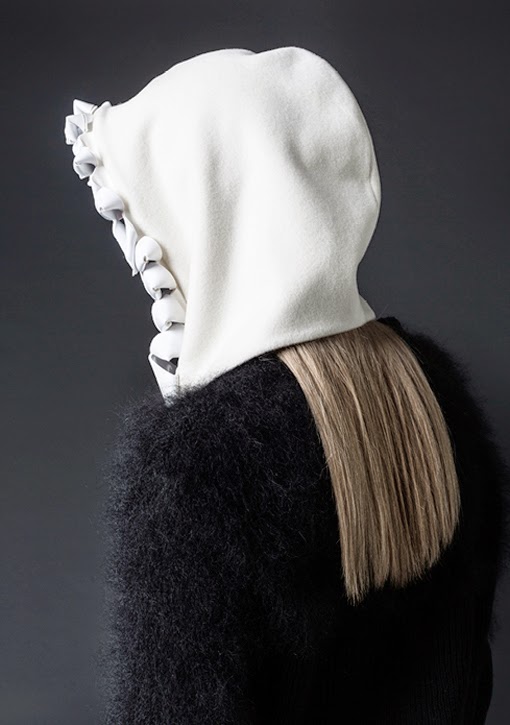 And as a method of adorning ourselves, I suspect its one of the very first things we did in our dim pre-history. Watch a small child a while and see how often something, anything ends up on their head. Its as natural to us as walking upright, and as soon learned. So when we started out, we stuck feathers in our hair and put the skins of beasts over our heads, as protection, and sympathetic magic. It is no surprise then that as centuries have rolled along feathers and hides have continued to play a significant role in headgear.
It made me sad in that in the 60s hats began to disappear from regular use for both men and women. They became a novelty, rather than an everyday item. To a major degree this is still so. The range of hats available, especially to men, is very limited, and most people don't wear them, since they fear "hat hair". I'm guilty of it myself.
So here are some fabulous people giving out fabulous in their fabulous hats.


 I want hats to come back in a BIG way for women and men. Lets make this a thing, mkay?
It made me sad in that in the 60s hats began to disappear from regular use for both men and women. They became a novelty, rather than an everyday item. To a major degree this is still so. The range of hats available, especially to men, is very limited, and most people don't wear them, since they fear "hat hair". I'm guilty of it myself.
So here are some fabulous people giving out fabulous in their fabulous hats.
Wednesday, September 3, 2014
Future Visions
Film, television, and literature have again and again tried to predict what the future will hold for us all with regard to what we will wear. They have inevitably failed every time. But why? Well, in my estimation its because there is no way to accurately predict enough of the social shifts that drive the Attire language to be able to get a clear picture.
That continual failure doesn't mean though that these attempts aren't worth review. So herewith you'll find a number of images from various sources with my comments about the good and bad points of each.


This first image is from a series of drawing done in 1893 that predicted how fashions would look in the 20th century. Though the clothes are absurdly costumey to our eyes, and largely unwearable to boot, the one thing that does resonate as accurate is the eclecticism of the outfits.
The next image is from a 1930s film of fashion predictions of the 21st century. The transparency is dead on the money for current runway trend, but the hair and makeup are pure 1935. The second in this series is from the same film. Here's where the major fail occurs. We are supposed to believe that the man of the 21st is wearing a loose fitting coverall with multiple attachments for all his tech needs. The only success here is the beard. Spot on hipster wear.
This image from the 1960s Italian film La Decima Vittima was designed by Courreges. As a prediction, its a fail on every level. Ursula Andress' knee length dress could come from nearly any time past 1950. The soldier's uniforms are laughable, both as costume and as predictions of things to come.
The original Start Trek. On one level this isn't fair, since the time this is set has not yet occurred. The reason to look at this though, is the way the designer, William Ware Theiss, took the hippie movement and morphed it into something else. What does speak to us is the bareness, the pattern mixing, and a certain level of gender blurring. Not a complete fail, but not a win.
Space 1999. Now, admittedly, these are intended to be uniforms, but there are things here to see. Hairstyles are completely contemporary to the later 1970s. The polyester outfits designed by Rudi Gernreich don't really express what happened in the real 1999 at all. The intent was to create a clean lined and forward thinking look, that expressed modernity. What resulted was a look that stamped 1977 all over every inch.
1982, Ridley Scott, Blade Runner. In my mind its one of the few times that future prediction gets anywhere near cultural reality. The biggest reason for my feelings about this are based on the design of the film showing a massively polyglot culture, where references are smashed together creating entirely new Attire phrases.
Meanwhile, back at Star Trek. The Next Generation broke no new ground with women's fashion, but the boys got pushed a round a good deal. Now, neither of these pictured looks is part of the vocabulary of fashion as yet. But that mini-dress/tunic sure has walked down more than one runway for men of late.
Oh, Chris Tucker, you scamp, you. The 5th Element, designed by Jean Paul Gaultier was a pretty successful evocation of another time. And he clearly had a ball doing it. The amount of cross cultural, cross sexual, cross everything, really things he produced speak quite well to our increasingly global culture. Was it a full on success? No, it wasn't really meant to be more than a cartoon, but certain aspects of it are fully contemporary to the 21st century.
And lastly, the Hunger Games films have taken that cultural melange notion and run with it. Is this edgy, far forward fashion? Nope. Pretty much anything you see here can and has walked a current runway, but as a subtle presentation of a near future time. I think this works admirably. Its a matter of waiting to see it if is as spot on as it feels.
So in each case, there are parts that succeed, and parts that don't, but that's ultimately because the language of Attire is far to complex and facile a thing to ever predict accurately.
Tuesday, September 2, 2014
Suit Of Power
In the realm of men's wear, there is no single more potent or iconic thing than the suit. Two or three pieced, double breasted, lounge or formal, the suit had dominated men's fashions for over 300 years. Starting out as a coat, waistcoat and breeches, it morphed over the 1700s, and emerged into the 1800s as the infant version of what we see today. Apart from a few changes in cut and fabrications, it has remained the same ever since.
 The suit as it existed 300 years ago was a clearly visible signal of status and wealth, since only men of means could afford to have such things made. Most men had to make do with pairing unmatched pieces together, as we so commonly do today. So in that sense the suit also operated as a block to those seeking to move up socially. It marked the wearer as of a certain class.
Those same things are still in play, though in different ways, right now.
The business community makes the most frequent use of the suit as an object of power and control. Since it is through fabrication, accessories and fit that hierarchy gets delineated, those at the top of the chain wear custom suits and only the most expensive of shoes, ties and such, partly because it marks them out, partly because its expected of them, and partly, simply because they can.
 The lesser employees are both kept in line because of the expense of purchasing and adequately maintaining their work wardrobes, and given a pathway to advancement by the subtle use of better and better attire. Learning how to play the Attire game in business is more of a help than many understand. But just ask any woman in business how difficult it is to walk the professionalism line with regard to apparel.
Outside of the business community the suit is a loud and clear signal that this person should be taken seriously, and dealt with with respectful deference. It also marks someone as being comfortable with the status quo and willing to go along with traditions as they stand. And this factor in the equation is the one that makes the current attempts to blast holes in the revered suit all the more difficult. Tradition and acquiesence are tough to break through. So the new shapes, choices of patterned fabrics and colors are all taking pokes at the armorial nature of the suit.


 The final aspect of suiting is its operation as a method of protection. When in a suit, the wearer is automatically kept apart from certain activities, and certain kinds of social interactions are less likely. People are less likely to approach a man in a suit without invitation, unless everyone is so attired, then the playing field levels out, and the suit becomes an invitation to converse.
In the long run, I see the potency and relevance of the suit diminishing year by year as more businesses find it is needless, and often even counterproductive to insist on suiting for their employees. The rise of the importance of the IT community with its nearly kneejerk resistance to suits and dressing up erodes our dependence on suiting up, daily. Couple those things with the ever increasing casual nature of how people dress in general, and the days of the suit are coming to a close.
Those same things are still in play, though in different ways, right now.
The business community makes the most frequent use of the suit as an object of power and control. Since it is through fabrication, accessories and fit that hierarchy gets delineated, those at the top of the chain wear custom suits and only the most expensive of shoes, ties and such, partly because it marks them out, partly because its expected of them, and partly, simply because they can.
Outside of the business community the suit is a loud and clear signal that this person should be taken seriously, and dealt with with respectful deference. It also marks someone as being comfortable with the status quo and willing to go along with traditions as they stand. And this factor in the equation is the one that makes the current attempts to blast holes in the revered suit all the more difficult. Tradition and acquiesence are tough to break through. So the new shapes, choices of patterned fabrics and colors are all taking pokes at the armorial nature of the suit.
In the long run, I see the potency and relevance of the suit diminishing year by year as more businesses find it is needless, and often even counterproductive to insist on suiting for their employees. The rise of the importance of the IT community with its nearly kneejerk resistance to suits and dressing up erodes our dependence on suiting up, daily. Couple those things with the ever increasing casual nature of how people dress in general, and the days of the suit are coming to a close.
Subscribe to:
Posts (Atom)