Sunday, December 21, 2014

Devotions

    Whatever your feelings on the subject of religion may be, there is something that is extraordinary about what we accoutre ourselves in to observe our religious practices.  These specialized garments are largely outside of time, since the baseline notion of communing with something eternal invests the structure and shape of the clothes to a great degree.  So most often these things are robe-
like, loose, and comfortable for standing, sitting, and kneeling for long periods.  And as a point of information, in this post I am not talking about the overt displays of power associated with some clerical vestments, with all their layers of symbolic meanings. Nor am I talking about complex rituals involving dance and costume.  I'm referring here to simple people doing simple devotions.
    Along with the loose and comfortable quality, something else is routinely a part of these things. Simplicity.  Because the idea of some kind of spiritual practice requires inward turning, the distractions of the outward world are not needed, in fact actively hamper achieving the place desired. So solid colors, clean and simple shapes, and a relative lack of ornamentation are the general rule.
    What we get left with is a poetical looking, and nearly sculptural image that diminishes the individual personality, in favor of the journey inward.  So we make manifest in physical terms our desire to be aligned with a divine force.  What I find most interesting about that, is that we associate closeness to divinity, not with outward display, but with the lack of it.  The more centered we become, the less we require ourselves to show to the world.
    Take a look at what I mean:
    Are there lots of other ways we make ourselves connected to what we see as divine?  Sure, endless numbers of them. But I wanted to focus only on this aspect of it for now, and allow us all to vicariously partake in that serenity.

Saturday, December 20, 2014

Scatter #36

    Coming up fast on the big blow out known as Christmas.  I hope those of you who involve yourselves are staying sane and happy through all the potential stresses.  Me?  Doing fine here, getting things together for my annual open house.
    But, enough of that, its Scattertime Kiddies!

   
I just couldn't stop looking at this image.  The colors, proportions, the variance of texture, and shape. All of it contributes to a statement that is arresting looking, and demands our attention, even though we are being told in many ways to keep our distance.  The violently orchid colored mohawk and the bandana over the face both say stay away.  Meanwhile the bared midriff is strangely provocative.  So we get a hint of encouragement along with the dismissal.  Its a look with a great deal on its mind to express.  I love it.
    30s Hollywood gangster, updated beautifully.  This broad spaced pinstripe suit is a terrific look, and he's accessorized it very well.  Sure, there are a few fit problems, but unless you can afford custom tailoring, there always will be.  Over all, I think its a marvelous re-do of a classic cinema trope.  Bravo, mister.
    In 1938, Else Schaiparelli produced one of her most remembered collection, her Zodiac collection.  This bakelite necklace is from that collection.  It bears the touch of humor and lyricism that is seldom absent from her work, and the design of the individual pieces was done in collaboration with Jean Cocteau, with whom she worked many times.  It can't be terribly comfortable to wear, with all those rigid irregular shapes, but sometimes one must suffer for one's art, mustn't one?
    This man's doublet is from France and was made in 1580.  Its unique in multiple respects. One is that its entirely of suede that has been embroidered. The second point of interest is that its heavily padded all over. Third is the attached suede neck ruff. And finally, the garment's purpose is of note. This doublet was meant to be worn while fencing.  That explains the padding, the textile, and the attached ruff.  Plus, this thing is just damned beautiful.  Oh, and they even included the very stylish peascod belly front to this doublet, so whoever was fencing with this fellow would know just how on point he was.  Sorry, couldn't help myself.
    Sometimes fashion photography draws from theater and literature for its inspirations.  This image from Vogue UK in 1992 features Christy Turlington as shot by Patrick Demarchelier, clearly taking its point from Eliza Dolittle in My Fair Lady.  An image of this sort is meant far less to display clothing being suggested for wear than it is meant to set a mood and establish a set of fantasies.  In this case the Pygmalion notion of a person's ability to be transformed.  All that said, I love this image for its subtle cheekiness.
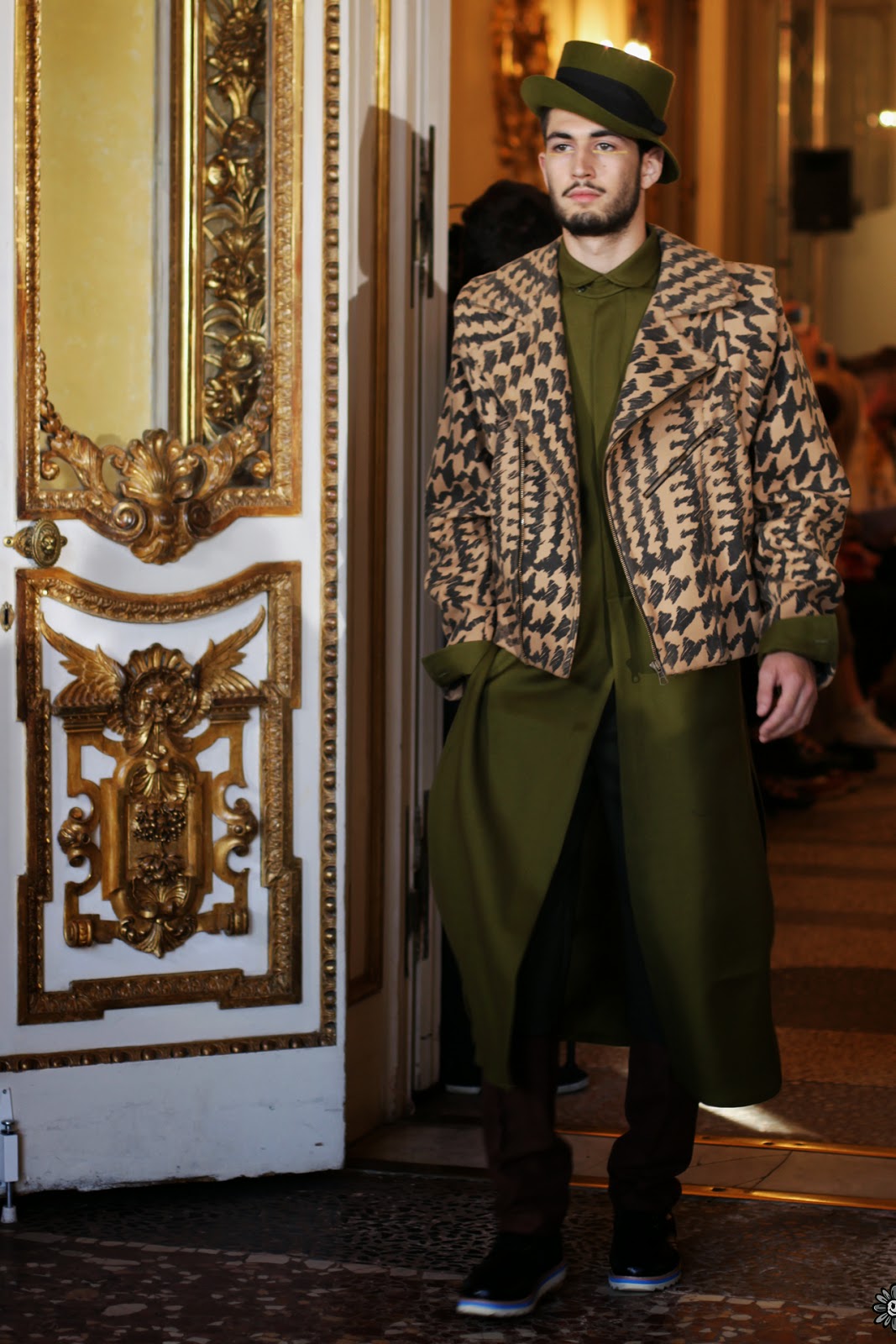
    You know me and my seeming relentless going on about the break up of menswear traditions.  Here's another effort that attempts to step outside that box.  Do I think this succeeds entirely. No, i don't the proportions are odd.  The clothes all look just a tiny bit too big for the model, but not over-sized enough to look deliberately so.  I like the tunic piece, but I wish the trousers under it ended sharply rather than bunching at the ankle.  The sleeve length on the houndstooth jacket is a bit too long; again, not long enough to look intentional.  Its an interesting concept, and it nearly works for me, just not completely.  Cleaned up I could easily see a look of this sort making its way into the Attire dialog.
    Serge de Nimes is the original name for denim.  Made first in Nimes, France, and dyed with indigo, it was meant as hard wearing material for working people.  It is still one of the most widely used fabrics in production, with garments of every description being made of it.  Most of us know that it came first into wide usage when Levi Strauss in the 1800s started using it to make blue jeans, but since that time it ha gained ever widening usage, becoming one of the primary materials from which the Attire language gets constructed.
    These was something about this image that drew me back to it repeatedly, so much so that I had to share it to you all.  That feather crown/headdress/hat is poetic in its expression.  Sure, its unlikely to see an real world usage any time soon, but as a visual point maker, a way of drawing the viewer to the face, its a wonderful tool.  I honestly can't tell whether those are feathers in use or some other thing shaped in a feather-like way. And in a sense that only adds to its appeal for me. I want to know,a nd the mystery hooks me in.
    Next up, this portrait by Sir Joshua Reynolds of Miss Susanna Gale painted in 1763-4.  This painting interests me because, yet again, we are in one of those transitional phases between pronounced looks.  We have lost rigidity of the prior decades, and the clothing has softened.  The main elements that will dominate women's clothing for the next 35 years are all present.  the half length sleeves, ending in cuffs, with lace. the low square neckline, the stomacher, the center front opening to the gown and the highly decorated petticoat.  All that will happen from this point will be variations on these pieces size and decoration, until the Revolution in France changes everything.
    For the gent with tons of moxie, might I suggest this Chinese metallic brocade jacket?  I am not sold on the quilted vest under it, but paired with the right things this could be Liberace fabulous.  What would you wear it with?  Cummon, now, you know you wanna try it on.
    This casual shot was taken by fashion and celebrity photographer Milton Greene, just post war, and its marvelous for how it shows working women, and how they really dressed to do their jobs.  The clean simplicity of their clothing, and the no nonsense feel to all of it tells you that these are women with things to do.  I'm dying to know what they're all responding to.
    And to finish out our scatter for this week, something deeply strange, hard to fathom, and really pretty wackadoo.  Rosalb De Mura sent this down the runway in 2010.  Its rare for me to say this, but even I am having trouble finding anything of worth in this effort.  Sure its edgy as hell, and clearly falls in the arena of the avant garde.  I can even see where some of the inspiration points come from. the tied on sleeves, are taken from the Renaissance fashion for detachable sleeves.  In fact, the repeated use of ties harks back to that period entirely.  And those booties/shoes?  I know they are meant as runway styling.  Can you imagine trying to walk safely in those?  How often would you trip yourself up on your own laces?  Sometimes even I have to shake my head and say, "whatever, dude".

That's it for this week, my friends. Have an awesome weekend!

Friday, December 19, 2014

Footwear, A Subset

    Yesterday my first facebook post touched on something I thought worth expanding on.
    There a many subsets to the totality of the Attire language, and there is significant overlap as well, one article being part of more than one sub-section, like a wedding dress is at once a dress, but also, formal wear,  and ritual wear.   But just now, I want to discuss footwear as a subset of the the sartorial tongue. 
    There has always been a desire to enhance upon the basic idea of a covering for the feet. As long as we have worn things on our tootsies, we've done so.  But never with the verve, the variety, and sometimes the complete abandonment of sense, of our current time.

    Some months back, I had occasion to be in a Nordstrom Rack with a woman friend who was looking, in vain, so it happens, for suitable work shoes.  As she was perusing the floor I found myself awestruck and not a little horrified by the sheer bulk of options on display.  Here was a very large store space, filled with row upon row of different shoes, sandals, boots and such.  And it struck me that every last one of them comprised a new, slight alteration on the base term, footwear.
    Now I have written and spoken before about the mind boggling bulk of the Attire language, when taken as a whole construct, but among all the subsets of the language, shoes for women seem to be one of the single fastest growing parts.
    The presence or absence of heels, their height, width, type, and materials is only one aspect of how this magnifies and expands.  When you start to think about it, it becomes nearly dizzying.  But what I've found most intriguing here in this continually growing section of the apparel language, is the lengths that we are going to, simply to say something new.
    I would have to place the beginnings of this somewhere in the early 20th century, when skirt heights lifted to the ankle, never to descend to the floor again , except as a novelty.  For daily wear, suddenly women's feet were fully visible, so the need for shoes that could contribute to the overall appearance grew.  Add to that the constant increase in garment production, fueled by a seemingly endless desire for novelty, and footwear soon became the accessory of choice for a huge number of women.
    Men, of course, have been trailing woefully behind, with the options still far more limited, the colors, finishes and details still largely hamstrung by conservativism. But that is starting to change as men are showing more desire to speak the Attire language with more facility and breadth.
    It will be interesting to see where this path we're treading will lead us.

Thursday, December 18, 2014

Traje De Luces

    There are few garments, or sets of them in the male section of the Attire language, that carry such instant recognition, or sexual potency, as the traje de luces, the suit of lights, so named for its dazzle and splendor.
  The Spanish tradition of bull fighting is falling out of favor as we gain understanding, at last, of the cruelty of such displays.  But that said, the sheer astonishment of the traje de luces cannot be denied, even in the face of that cruelty.  Looked at as a separate thing, as manifestation of the human creative impulse, and a desire to express something profound about the male of the species, the traje de luces, is nearly unique in its ability to elevate the male to some rarified pinnacle that typically we only permit women to surmount.
    Men are rarely permitted, outside of the military,  to seem apart from us, godlike and serene, above the normative of humanity.  Te traje de luces is a set of garments that is designed to do exactly that. It divorces that man from normal human behaviors and places him somewhere else.  We may indeed decry where he ends up, abusing and killing an innocent animal for sport only, but in this place and time I am speaking only of the astonishing, glittering, and altogether magnificent image that gets created.
    The people who build these suits spend hundreds of hours in patient hand labor cutting, sewing, and above all, decorating with embroidery and other embellishments, these amazing creations. The end result is a suit of clothing that expresses the essence of our notions of the male in real form. Lean, strong, simple seeming, and yet possessed of a vast complexity of structure and adornment. It is the peacock ideal made manifest.
    Its time is coming to and end, I know.  And honestly I am not sad that such activities are falling behind us.  I am however sad, that this incredible example of the tailor's art, and this singular paean to the male will die away with the loss of the bull fighter. 
    Feast your eyes, if you will, on some of the most remarkable workmanship ever brought to bear on human apparel.
    We're amazing thing, we humans.

Wednesday, December 17, 2014

We Wear Ritual

    We do it every day, whether we realize it or not.  We wear rituals all over our bodies, and we even sometimes make them permanent parts of us by tattooing or piercing ourselves, or making other modifications.  I haven't spoken of this before in this way. but its important: perhaps the single most important thing in the whole construct of the Attire language.
    It is the connection point, the life line, if you will, to our dim and essential beginnings.  We create and foment rituals to carry us through our day, our world, and our lives.  We still need them, you know, these little rituals, to make ourselves feel safe, and part of something greater than ourselves; so we won't feel so very alone.
     When I say rituals, what exactly do I mean?  Do I mean smells and bells, sacrifices, and dogma?  In a sense, I do.  Though we would never conceive of them in that way. We have too often, and far too long considered that what we put on our backs is a subject for subtle derision, and ultimately, dismissal.  The reality is far, far different, and more deeply seated in ourselves, and our cultural, physiological, psychological past.
     But, when we choose to starve ourselves to fit a certain size dress, or pair of pants; when we work out relentlessly to have an 8 pack, or a butt you could break a tooth on; what is that but a ritual?  What is it but a giving over of ourselves to something outside of us to which we feel we must claim allegiance?  What is it but a desire to connect by physical, visual association, to a group, a tribe, a nation, or a culture?
    It is, in fact, a ritual, or rather a series of them we indulge in every day, that help cement our belonging in the culture we claim as ours, whatever, wherever, and whenever that might be.  We give a sacrifice each day. We give the sacrifice of a workout at the gym, denying ourselves a cookie, putting on make up, wearing undergarments, putting product into our hair, wearing a uniform, and endless variations of these ideas that stream behind us as far as we can imagine.  We give ourselves over, in one way or another, to the concept of a society to which we wish to belong.  We sacrifice a bit of ourselves each day, while at the same time, we try so desperately to present ourselves to the world, to be approved of, and seen. 
    Sometimes, the way we dress can take on the force of dogma. We must dress a certain way to do business, seek a mate, engage is socialization, approach our deity, if we believe in one, or face the death of a loved other.  So, our speaking of the Attire language, can have a ritual, wrote aspect to it, as well as a free-wheeling one.  Women continue to wear high heeled shoes, even though they are painful, hampering to movement, and in a sense degrading to them.  Men continue to wear suits, though they are similarly hampering, and also  nearly devoid of expressivity. Its dogma, culture, tradition. It is What Is Done. 
    When we think of ritual dressing we think of religious garments, or the panoply of royalty, but its not just their province.  It is the province of everyone, everywhere.
  Those of us who wear the same sort of t shirt, hoodie, and jeans every day, are engaging in a ritual, all unknowing.  When we wear fetish gear, its a ritual. When we dress up to go out, its a ritual.  I can tell you from personal experience, that getting dressed in my full on Scottish clan gear is indeed a ritual, requiring at least 45 minutes to get it just right.  And of course, because its a ritual, I must get it right.
    And for most of us, getting it right means something; even when its just throwing on whatever smells the least and has the fewest wrinkles, it means something.  So think about this a bit, and observe yourself.  Do you put things on always in a particular order, even when it doesn't really matter? 
If you do, you've ritualized.   We all do.  Call it habituation if you wish: its also a ritual. Don't be ashamed, or embarrassed. Its human, natural, and just fine. At the end of this, or any other day, its part of what we do to proclaim that we are part of the Human Family.  And there's no reason at all to deny that.

Tuesday, December 16, 2014

Abondanza!

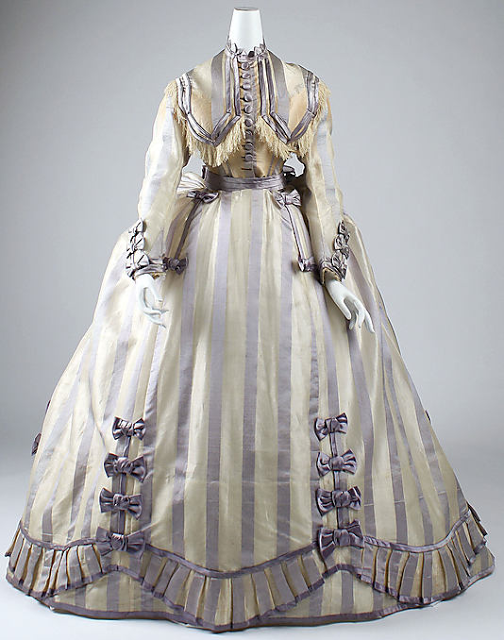
    The 19th century is truly unparalleled for the sheer amount of textiles, decoration and variability of silhouette that occurred.  No other time period showed such radical and amazing breadth of distance between ways we visioned women.  The 20th, and surely so far the 21st, have nothing on it, truly.
  We went from 1800 where women comparisoned themselves in un-ornamented columnar gauze gowns with nothing under them, and only slippers and a paisley shawl, to the vast, varied, and infinitely fussy looks that typified the later Victorian era, loaded to bear with lace, ruffles, ruching, pleats, boas, bags, hats, fans, and gloves.

    This massive range of expression about how we envisioned women speaks very loudly.  The first versions were meant to imply a classical innocence and vulnerability to women, keeping them in place by making them seem too fragile to venture out; even though the true genesis of this look had been the growth of the Republican ideal in France especially, and its notions of human equality.  As the century continued, and men moved into industry more and more, women became more for these men, objects, that could display their wealth and status through the sheer volume and variety of their apparel.  Women largely cleaved to this notion, since so little else was afforded them, and trumpeted their position in society through their extravagant and incredibly complex manner of dress.
    We saw the silhouette go in and out like a squeeze box.  The waistline started out the century just under the breast, and ended at its natural position, but fiercely compressed within a corset designed to create that ideal hourglass shape.
    Where women started the 19th century with relative freedom of movement because of the lack of hampering layers, and a reasonable skirt length, by the mid 20s it was all about piling on more, more and still more.
  And when the sewing machine entered the world, the possibilities expanded still further, pushing both ladies of fashion, and their dressmakers, to ever higher levels of decorative detail and structural complexity in order to make sure their status was understood clearly.
    Its no wonder at all that when the 20th century dawned, and designers like Poiret were championing looser, simpler clothes, that women of every age and status cheered the new mode.
    Here for your perusal are a bevy of fantastical frocks that explain far better than I ever could the heights, breadths, and lengths to which human inventiveness, and the desire to one up the rest of the crowd, could drive us.
    And when writers talk about how long it took to get dressed, they aren't exaggerating one bit.  A single dress could have dozens of hooks and eyes, rows of button so tiny they required a buttonhook, ribbons to tie, and snaps to close.  It really must have been an exhausting business for all involved.